
Trailer Air Tanks — Steel & Aluminum Air Reservoirs
The trailer air tank stores the compressed air that runs the entire brake system, and its capacity has to keep pace with how many chambers it feeds and how far it sits from the tractor's compressor. Sigma builds steel and aluminum air tanks in the capacities and mounting styles that cover single and tandem-axle trailers, with the drain valves and corrosion protection that fleets running in humid coastal ports actually need. This same reservoir gets called aluminium air tanks, aluminum air tanks for trailers, or aluminum air tanks for semi trucks — the sizing and mounting logic below stays the same.
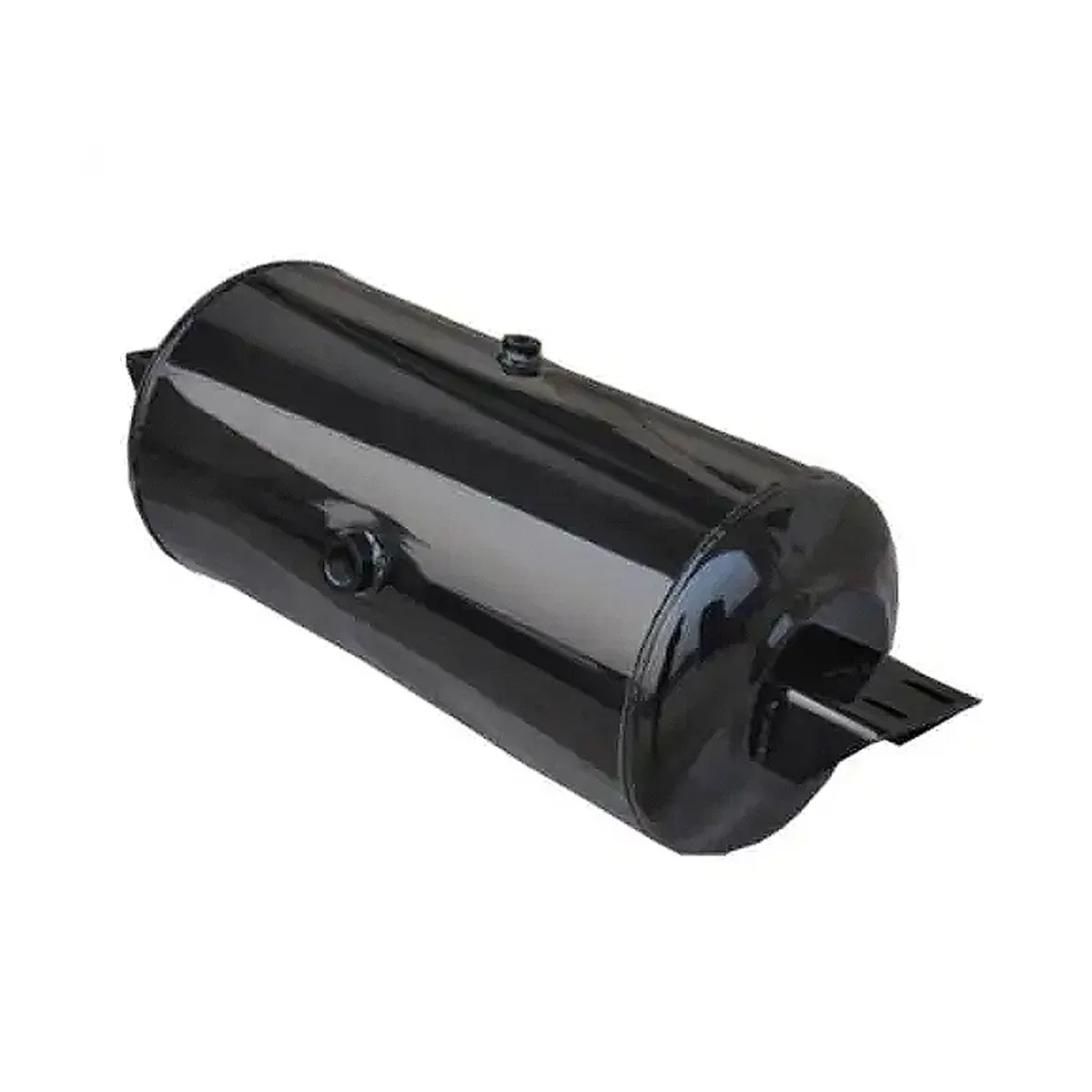
Specifications
| Capacity | 20L / 30L / 40L / 60L (5–16 US gallons) |
|---|---|
| Material | Carbon steel (standard) or aluminum (weight-optimized) |
| Working pressure | Rated to 150 psi (10.3 bar), tested to 2x working pressure |
| Mounting | Cross-member strap mount or frame-rail bracket mount |
| Ports | 2–4 NPT ports for supply, delivery, and gladhand lines |
| Drain valve | Manual twist-drain or automatic moisture-ejector valve |
| Coating | E-coat + powder-coat steel, or bare/anodized aluminum |
| Standard | Hydrostatic tested to DOT/ECE air reservoir requirements |
The Air Tank's Role in the Brake Circuit
Air enters the trailer through the gladhand couplers from the tractor's compressor and air dryer, and the trailer air tank is where that supply is stored under pressure so the brakes have air available instantly on demand rather than waiting on the compressor's output rate. When the driver applies the brakes, air drawn from the tank travels to each brake chamber, and the tank's stored volume is what keeps pressure stable through repeated applications on a long descent, rather than pressure dropping with every pedal stroke.
Tank volume matters directly to brake performance: a tank sized too small for the number of chambers and the length of the air lines it feeds will show pressure lag on repeated brake applications, which a driver experiences as a spongy or progressively weaker pedal on a long grade. This is why tank capacity is specified against axle count and chamber size, not chosen by whatever fits the available frame space.
The tank also serves as a moisture trap — compressed air carries water vapor from the compressor, and that moisture condenses in the coolest part of the system, which is usually the tank. Left unmanaged, that water freezes in cold climates and blocks valves, or simply corrodes the tank from the inside out over years of service. Every design decision on a trailer air tank, from steel gauge to drain valve type, traces back to managing that moisture.
Multiple trailers on the same combination — a truck pulling two or three trailers, common on long-haul routes across Southern Africa and parts of the Middle East — compound this demand further, since each trailer's tank has to hold enough reserve to operate independently if the air supply line between units is disconnected or fails — the same logic behind a converter dolly air tank, an auxiliary reservoir on the dolly itself for exactly this failure mode. This is the exact scenario behind a tractor trailer air tank sizing question we get often: how much reserve a semi trailer air tank needs when it's one of two or three units running behind a single tractor rather than operating alone. This is also why the tank is treated as safety equipment rather than a simple air store: its condition directly determines whether the brakes still have force available in exactly the failure scenario where that force matters most.
Sizing: Capacity for Trailer Length and Axle Count
Trailer air tank sizes run 20L to 60L; matching the number starts with axle count: a single-axle trailer with two brake chambers and short air lines can run comfortably on a 20L or 30L tank. A tandem or tridem trailer with four to six chambers and longer runs from tank to chamber needs 40L to 60L of reserve capacity to maintain stable pressure through repeated stops, particularly on mountain routes or mining haul roads where the brakes see sustained heavy use between refills from the tractor.
Regulations in most markets require a minimum reserve — enough stored air to deliver a set number of full brake applications even if supply from the tractor is cut off, which is the scenario a trailer breakaway or air-line rupture creates. Undersizing the tank does not just cost pedal feel on a long descent; it can leave a disconnected trailer without enough stored air to hold the spring brakes applied for as long as the safety margin assumes.
We size tanks against declared axle count and chamber type at the order stage rather than selling by tank diameter alone, and we cut custom aluminum air tanks to non-standard capacities on request, because two trailers of the same overall length can have very different air demand depending on axle configuration and whether the trailer runs lift axles that add chambers only when lowered. When a fleet asks about an air tank semi trailer application without a firm chamber count yet, this is the first thing we ask for — the answer changes the recommended capacity more than trailer length ever does.
It is also common, and usually a mistake, to size the tank purely on the trailer's build year or a competitor's spec sheet without checking the actual chamber types fitted. A trailer re-fitted with larger Type 30 spring chambers in place of the original Type 24s, for example, draws more air per application than the tank was originally sized for, and the tank should be reassessed at the same time as the chamber upgrade rather than left as an afterthought — a well-matched chamber and drum upgrade delivers less benefit than expected if the air supply behind it cannot keep pace.
Steel vs Aluminum Air Tanks
Steel is the default material for trailer air tanks because it is inexpensive, easy to weld into cross-member and bracket assemblies, and tolerant of the rough handling a trailer frame absorbs over its service life. The tradeoff is weight and a need for real corrosion protection — a bare steel tank in a coastal or high-humidity market will rust from the outside in within a few seasons, and from the inside out if drain maintenance is skipped. We e-coat the tank interior and exterior before powder-coating, which meaningfully extends service life over a painted-only tank.
Aluminum tanks cost more but weigh roughly a third less than an equivalent steel tank and do not rust, though they can still corrode internally from trapped moisture if drain valves are neglected — aluminum resists rust, not all corrosion. This is the aluminum air tanks for trucks and small aluminum air tank end of our range, down to 20L. Fleets running weight-sensitive routes where every kilogram of tare weight reduces payload, or operators in the most corrosive coastal and marine-adjacent environments, are the buyers where the aluminum premium pays back fastest. For most general highway and mining fleets, a properly coated steel tank at lower cost is the better value.
Wall thickness is worth checking on any tank regardless of material, since a thinner-gauge tank saves a small amount of weight and cost but has less margin against corrosion pitting before it fails a pressure test. We manufacture to a wall thickness that keeps a comfortable safety margin over the minimum required at rated working pressure, rather than trimming to the thinnest gauge that passes a new-tank test, because the tank that matters is the one still in service after five years outdoors, not the one fresh off the production line.
Weld quality at the tank's end caps deserves the same attention as the shell material itself, since the circumferential weld joining the cap to the cylindrical body is the most common failure point on a low-quality tank — not the flat plate sections, which see even stress distribution. We use automated seam welding on this joint specifically because a hand-welded cap seam is where inconsistent penetration is most likely to hide, and it is the last place you want a hidden defect on a pressure vessel that sits inches from the axle and the road surface.
Mounting: Cross-Member vs Frame-Rail
Cross-member mounting uses a steel strap or saddle bracket welded between the trailer's main frame rails, positioning the tank low and central under the trailer bed — this is the most common configuration on flatbed and platform trailers where frame-rail space is otherwise open. Frame-rail mounting bolts or welds a bracket directly to the outside face of a main rail, which is more common where the center of the frame is occupied by a hydraulic reservoir, spare tire carrier, or toolbox, as it often is on tipping trailers.
Whichever mounting style, the tank should sit with its drain valve at the lowest point and angled slightly so accumulated water actually reaches the valve rather than pooling in a dead zone at the tank's midpoint — a poorly angled installation defeats the drain valve's purpose regardless of how good the valve itself is. We supply mounting brackets matched to standard trailer frame rail spacing, and can weld custom saddle brackets for non-standard frame widths on request.
Ground clearance is worth checking against your specific route conditions, not just the trailer's on-paper spec — a tank mounted at the standard height on a highway-only chassis can strike ruts or rocks on an unpaved mine or quarry access road that the same trailer never encounters on a sealed road. Fleets running mixed on- and off-road routes sometimes ask us to mount the tank slightly higher within the frame envelope, trading a little accessibility for drain maintenance against a meaningfully lower risk of impact damage on rough terrain.
Port count and placement also depend on mounting position — a tank feeding both a service line and a separate parking/spring line typically needs three or four NPT ports rather than two, plus a dedicated port for the drain valve itself. We machine port bosses to standard NPT thread sizes so fittings, gauges, and drain valves already in a workshop's parts bin thread straight on without adapters, which matters for fleets maintaining trailers across several countries where sourcing a specific fitting locally is not always straightforward.
Maintenance: Drain Valves and Corrosion Control
Every semi trailer air tank valve on the unit — the drain, the NPT supply and delivery fittings, and the moisture-ejector where fitted — needs checking on the same maintenance pass, since a valve that's stuck open or weeping slowly undermines tank pressure just as surely as a crack in the shell.
Checking the trailer air tank drain valve is the single most skipped maintenance task on a trailer — manual twist-drain valves need to be opened by hand at the start of each duty cycle or at minimum weekly, to purge the water that accumulates from normal compressor operation — this is the single most skipped maintenance task on a trailer, and it is also the single biggest driver of tank corrosion and frozen valves in cold weather. Automatic moisture-ejector valves solve the compliance problem by venting accumulated water on every pressure cycle without driver action, and we recommend them for any fleet that cannot guarantee manual drain discipline across every unit and every driver.
Beyond drainage, inspect the tank shell for surface rust bubbling under the coating, particularly around the mounting straps where paint is most easily chipped during installation or service — touch up any bare steel promptly, since rust under a coating spreads faster than rust on bare, breathable steel. A tank that has been in service more than five to seven years in a humid climate is worth a hammer-tap sound test or, better, a hydrostatic pressure check before it goes back into service, since internal corrosion is invisible from the outside until the shell has already thinned significantly.
A tank that fails a pressure test, or one where drain water consistently runs rust-colored rather than clear, should be replaced rather than patched — welding a repair onto a pressure vessel that has already thinned from corrosion changes its stress distribution in ways that are hard to certify as safe, and the cost of a new tank is small next to the cost of a brake system that loses air pressure on the road. Keep a simple log of drain water condition across the fleet; a tank that starts showing rust-tinted water earlier than its peers is worth inspecting ahead of schedule rather than waiting for its next routine service.
Frequently Asked Questions
What size air tank does my trailer need?
Should I choose a steel or aluminum air tank?
Do I need a manual or automatic drain valve?
How is a trailer air tank mounted?
How often should an air tank be pressure-tested?
Do you sell trailer air tanks for sale in bulk to fleets, not just single replacement units?
Tell us the part you need and your destination port — we'll send specs & a quote today.
Reply within 24 hours — or WhatsApp us at +86 199 5331 6215.