
Fifth Wheel Couplings — 2″ & 3.5″ Semi-Trailer Saddles
A fifth wheel coupling — the coupling hitch and kingpin lock system — is the load-bearing joint between tractor and semi trailer, carrying the entire kingpin load through a forged top plate and spring-loaded jaw lock, one of the coupling locks for trailer-to-tractor connections rated for full kingpin load rather than a bolt-on caravan security lock. We build fifth wheel for tractor trailer combinations in fixed and slider assemblies, in 2 inch trailer coupling and 3.5 inch kingpin bore, sized for line-haul, heavy-haul, and off-road duty, and export them as complete assemblies ready to bolt onto your mounting brackets.
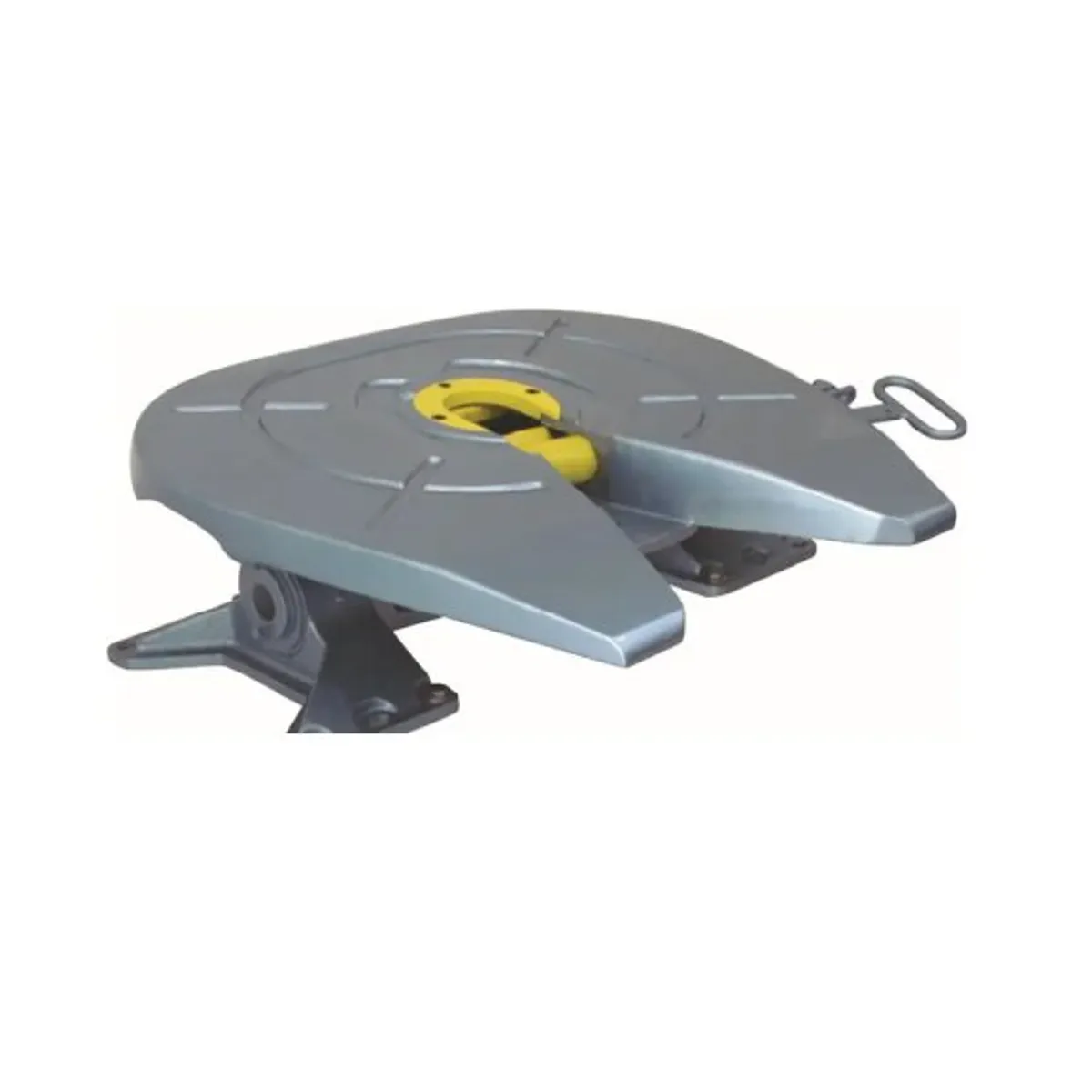
Specifications
| Kingpin bore | 2″ (50 mm) standard duty / 3.5″ (90 mm) heavy-haul |
|---|---|
| Static capacity | 24,000 kg – 55,000 kg depending on model |
| Mounting type | Fixed (bolt-on bracket) or slider (air-operated, 500 mm+ travel) |
| Top plate material | Forged carbon steel, induction-hardened wear strips |
| Lock mechanism | Single or double jaw with secondary safety latch |
| Tilt / articulation | ±12° tilt, ±90° horizontal oscillation |
| Mounting height | 1,150 – 1,450 mm (adjustable with brackets) |
| Standard compliance | SAE J700, 10-hole bolt pattern |
| Surface finish | Primer + gloss enamel or hot-dip galvanized |
What's in a Fifth Wheel Coupling
The fifth wheel plate is a single forged or fabricated casting shaped to cradle the trailer's kingpin and take the vertical, longitudinal, and lateral loads generated in braking, cornering, and hill starts. Under the plate sits the jaw assembly — a spring-loaded throat that closes around the kingpin shank and locks it in place, backed by a secondary lock so the jaw can't release under vibration alone. A release handle on the side, sometimes cable-routed to the cab, pulls the lock open for uncoupling. The top surface carries grease points and, on higher-mileage units, a low-friction wear plate so the trailer can pivot through a turn without scoring the steel. We pair every fifth wheel with a matching king pin ground and hardened to the same bore tolerance, since a mismatched pin-to-jaw fit is the single biggest cause of premature wear on a saddle coupling. The numeral abbreviation is just as common in the trade: a 5th wheel plate and a fifth wheel coupler are the same forged top plate, and a 5th wheel kingpin the same hardened pin, whether it goes onto a 5th wheel tractor or into a fleet order of plates for semi trailers. The low-friction wear surface is what the trade calls a 5th wheel skid plate, 5th wheel slick plate, or 5th wheel teflon plate — the same wear pad that needs 5th wheel lube, or a full 5th wheel lube plate swap, at every service. The plate's oscillating fifth wheel coupler design — the ±12° tilt and ±90° horizontal oscillation listed in the spec table above — lets the trailer articulate over uneven ground without transferring twist into the frame.
2 Inch vs 3.5 Inch Fifth Wheel — Picking the Bore
Most on-highway trailers in Africa, the Middle East, and Southeast Asia run a 2 inch fifth wheel — a 50mm trailer coupling — rated for gross combination weights up to roughly 36 tonnes on a standard tandem tractor. Once you move into logging, mining haul roads, tanker convoys, or oilfield rig-moving trailers where combination weight climbs past 60 tonnes, the 2 inch pin runs out of shear and bearing capacity and the industry moves to a 3.5 inch fifth wheel (90 mm kingpin). The 3.5″ assembly uses a heavier forged top plate, a wider jaw throat, and a reinforced mounting bracket to match — you can't simply bolt a 3.5″ top plate onto a 2″ mounting frame and expect the load path to hold. If your fleet mixes both trailer types, tell us the axle configuration and typical payload and we'll spec the coupling to the combination, not just the pin size on paper.
Fixed Mount vs Slider Fifth Wheel Assembly
A fixed fifth wheel bolts straight to the tractor frame at one position and never moves — simplest, cheapest, and the right call for a dedicated tractor-trailer pairing that never changes axle loading. A slider fifth wheel assembly rides on rails and can be locked at different fore-aft positions, typically over 500 mm of travel in 100 mm increments, released by an air cylinder pulling the locking pins. Sliders let a driver shift weight between the drive axles and the trailer axles to hit bridge-law axle weight limits without reloading cargo, and they let one tractor tow trailers with different kingpin setback. The tradeoff is more moving parts to inspect — slide rails, locking pins, and the air line all need to be checked on schedule, whereas a fixed mount only needs the jaw and grease points watched.
Sourcing from a Fifth Wheel Manufacturer
We forge and machine fifth wheel top plates and jaw assemblies in-house at our Liangshan facility, so bore tolerance, jaw spring rate, and heat treatment are controlled from raw billet through final assembly rather than bought in from three different subcontractors. Every coupling is proof-loaded and gauge-checked before it ships, and we keep tooling for both 2″ and 3.5″ bores plus the common SAE J700 bolt patterns used by Fontaine- and JOST-style mounting brackets, so a replacement plate from us drops onto an existing bracket without adapter work. Container-load orders get palletized with grease already applied to the plate and jaw — no re-machining or fitting needed at the yard. We also machine inverted 5th wheel coupler plates for low-profile mounting applications where deck height is restricted, built to the same jaw and kingpin bore spec as our standard-orientation units.
Gooseneck Coupling vs Fifth Wheel — and Adapters Between Them
A gooseneck coupling connects a trailer through a ball-and-socket hitch mounted in the bed of a pickup or medium truck rather than a kingpin and jaw — common on horse floats, flatbed and equipment trailers under about 15 tonnes GCW, including 10t gooseneck coupling capacity units for mid-weight equipment trailers. It's a different connection geometry from a fifth wheel, but the two share enough mounting footprint that gooseneck to 5th wheel coupler and gooseneck to fifth wheel coupler adapter plates exist to let a truck fitted with a gooseneck ball run a kingpin trailer, or the reverse, without swapping the bed hardware. We don't forge the ball-and-socket gooseneck hitch itself, but we can advise on kingpin-side compatibility and supply the fifth wheel half of a gooseneck-to-fifth-wheel conversion where a customer is standardizing a mixed fleet onto one trailer type.
Installation, Greasing, and Wear Checks
A new fifth wheel coupling should be greased at the plate surface and jaw pivot before its first coupling and then on a fixed interval — weekly for line-haul, more often in sandy or wet operating conditions where grit works into the jaw throat. Check jaw-to-kingpin clearance with a feeler gauge or the manufacturer's go/no-go gauge every service interval; clearance past spec means the jaw has worn enough that the kingpin can shift under braking, which shows up as a knock or clunk on deceleration. The jaw lock and secondary safety latch are the trailer coupling lock and the coupling lock for trailer-to-tractor connections that actually hold the load together, and they're the parts worth inspecting most closely at every service — a worn or sticking lock is a far more urgent issue than surface wear on the plate itself. Also check the mounting bolts to the bracket for torque and the bracket-to-frame welds or bolts for cracking, since a coupling that's perfect on its own can still fail at the mounting interface. See our fifth wheel coupling guide for a full inspection checklist and torque values by model.
Frequently Asked Questions
How do I know if I need a 2 inch or 3.5 inch fifth wheel?
Are your fifth wheel couplings compatible with Fontaine and JOST mounting brackets?
What's the difference between a fixed and a slider fifth wheel assembly?
How often should the fifth wheel plate be greased and inspected?
What load capacity do your fifth wheel couplings carry?
How do you couple and uncouple a tractor trailer?
What's the best trailer coupling lock for a mixed fleet?
Tell us the part you need and your destination port — we'll send specs & a quote today.
Reply within 24 hours — or WhatsApp us at +86 199 5331 6215.