
Jockey Wheels — A-Frame Trailer Jacks
A jockey wheel — also called a trailer jack wheel or, in North America, a tongue jack — is the small retractable wheel mounted on a trailer's A-frame, sometimes searched as jockey wheel on trailer fittings or an a frame trailer jack, that lets you raise, lower, and roll the front of the trailer when it's uncoupled from the tow vehicle — standard on box trailers, plant trailers, caravans, and converter dollies too light to need full semi-trailer landing gear. We stock side wind and top wind jockey wheel assemblies — including caravan jockey wheel, stabilizing trailer jacks, and A-frame replacements — from 350 kg up to heavy duty 2000 kg capacity, in clamp-on and bolt-on mount, with pneumatic or solid rubber wheels.
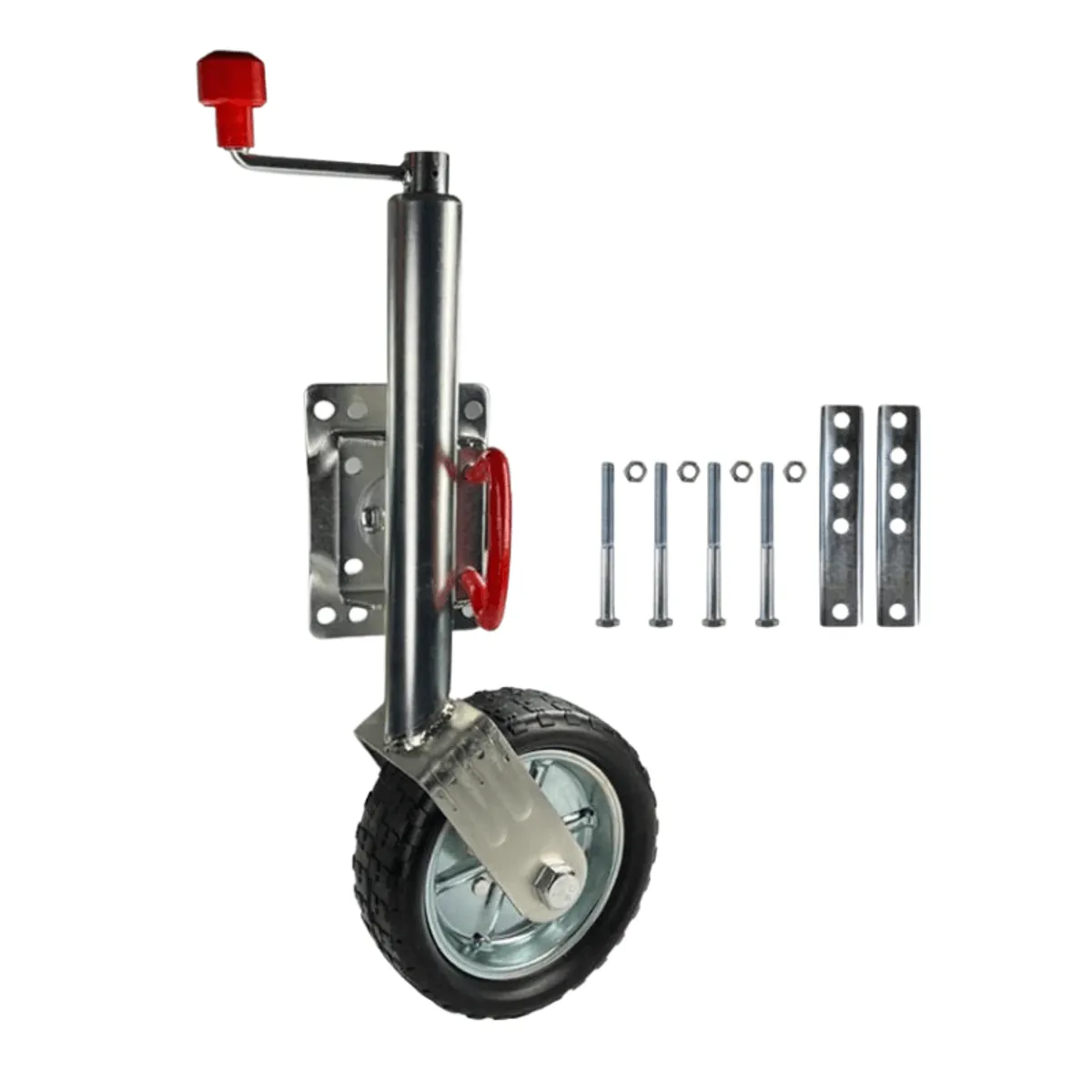
Specifications
| Static capacity | 350 kg – 2,000 kg (heavy duty) |
|---|---|
| Wheel diameter | 150 mm (6″), 200 mm (8″), 254 mm (10″) |
| Wheel type | Solid rubber or pneumatic (air-filled) |
| Wind type | Side wind (crank) or top wind |
| Mounting | Clamp-on (48/60 mm A-frame) or bolt-on plate |
| Travel / stroke | 300 – 450 mm typical |
| Tube material | Welded steel tube, zinc-plated |
| Retraction | Swing-up or telescoping, stowed clear of ground clearance |
Side Wind vs Top Wind Jockey Wheel
A side wind jockey wheel has its crank handle on the side of the mounting tube, turning a worm gear that drives the wheel up or down — this is the more common setup on box trailers and caravans because the handle stays clear of the drawbar and is easier to reach from either side of the trailer. A top wind jockey wheel has the crank on top of the assembly, turning a screw thread directly, which tends to lift faster per turn but puts the handle in a spot that can interfere with a low-mounted coupling eye or drawbar brace. Side wind units generally handle higher loads more comfortably because the gear reduction gives more mechanical advantage for the same crank effort, which is why most heavy duty jockey wheel models above 750 kg are side wind rather than top wind. For heavier tandem-axle trailers or caravans where cranking a heavy duty jockey wheel is tiring, an electric jockey wheel for caravan and dolly use — also known regionally as a motorised jockey wheel, motorized jockey wheel, caravan motorized jockey wheel, or powered jockey wheel for caravan fit-outs — replaces the hand crank with a 12V motor and rocker switch, letting one person raise or lower the assembly without leaning into the handle. A hydraulic jockey wheel or hydraulic trailer jack swaps the crank for a hand-pump ram instead of a motor, giving heavy-lift ease without the wiring an electric unit needs — a common choice for horse floats and heavier tandem trailers where mains power isn't handy. The extra motor and wiring add cost and a failure point a manual side wind or top wind jockey wheel — sometimes ordered simply as a manual trailer jack — simply doesn't have, so it's worth it mainly for solo operators or heavier-capacity units.
Choosing a Jockey Wheel for Trailer Weight and Use
Match the jockey wheel's rated capacity to the trailer's ball weight or drawbar load, not the trailer's total gross weight — the jockey wheel only ever carries the static nose weight when parked, typically 8-15% of loaded trailer weight. A light box trailer or single-axle plant trailer usually needs only a 350-500 kg jockey wheel assembly; tandem-axle trailers, boat trailers, and converter dollies with heavier tongue weight need 750 kg to 2000 kg capacity. Wheel size matters too — a small 150 mm wheel is fine on hard standing and workshop floors, but a trailer that gets jacked up on gravel or soft ground tracks better with an 8 inch jockey wheel, a 10 inch jockey wheel, or a pneumatic jockey wheel fitted with an air-filled tire, since a small hard wheel sinks in and makes the trailer harder to roll into position. Check the jockey wheel wheel diameter against your typical parking surface before ordering — it's an easy spec line to overlook, but it's the difference between rolling the trailer into position in one push and having to walk it forward in short jerks. We also offer a matching jockey wheel cover for caravan and long-term storage use, sized to the wheel diameter ordered.
A-Frame Jack Mounting — Clamp-On vs Bolt-On
Clamp-on jockey wheel assemblies — a jockey wheel 48mm clamp is the common size — grip the A-frame drawbar with a U-bolt or clamp bracket sized to standard 48 mm or 60 mm square tube, and can be repositioned or swapped without cutting or drilling the frame — the practical choice for retrofits and repairs. Bolt-on assemblies mount through a flat plate welded to the drawbar and are the stronger, more permanent option, standard on factory-built trailers and heavier dollies where the jockey wheel needs to stay rigid under a higher nose load without shifting on the tube. Some fleets also spec a jockey wheel receiver — a tube welded to the frame that the jack's shaft slides into and locks — or, for towing over rough ground, an off road jockey wheel on a trailer jack swivel mount that lets the wheel pivot to trail straight; tell us which mounting style your frame uses and we'll match the shaft diameter and lock pin spacing. If you're sourcing a caravan jockey wheel replacement rather than fitting a new trailer, check whether the existing mount is clamp or bolt pattern before ordering, since converting from one to the other means modifying the A-frame.
Jockey Wheel vs Landing Gear — Which Does Your Trailer Need
Jockey wheels and semi-trailer landing gear solve the same basic problem — supporting the trailer when it's not coupled — but they're built for very different loads. A jockey wheel handles the nose weight of a drawbar trailer or dolly, usually under two tonnes, through a single wheel that rolls for easy positioning. Landing gear on a fifth-wheel semi trailer supports 12-28 tonnes of static load through twin crank-operated legs with feet that plant on the ground rather than roll, because a semi trailer doesn't need to move once it's parked and uncoupled. If your trailer couples via a drawbar and coupling eye rather than a kingpin and fifth wheel, it needs a jockey wheel, not landing gear.
Frequently Asked Questions
What capacity jockey wheel do I need for my trailer?
What's the difference between side wind and top wind jockey wheels?
Can I fit a jockey wheel without welding anything to my trailer?
Do heavy duty jockey wheels come with pneumatic tires?
Is your jockey wheel a compatible replacement for AL-KO, Knott, Bulldog, Fulton, Ifor Williams, Optitec, or Boss jockey wheels?
Do I need a jockey wheel or landing gear for my trailer?
Tell us the part you need and your destination port — we'll send specs & a quote today.
Reply within 24 hours — or WhatsApp us at +86 199 5331 6215.