
Trailer Axles
We forge and machine trailer axle assemblies for semi-trailer builders, fleet workshops and parts distributors, from 13 ton single axles to 28 ton tandem sets. Every axle of trailer we ship leaves with the beam, spindles, hubs and brake mounting already matched to the customer's suspension and wheel spec, so it bolts or welds straight into the running gear without rework.
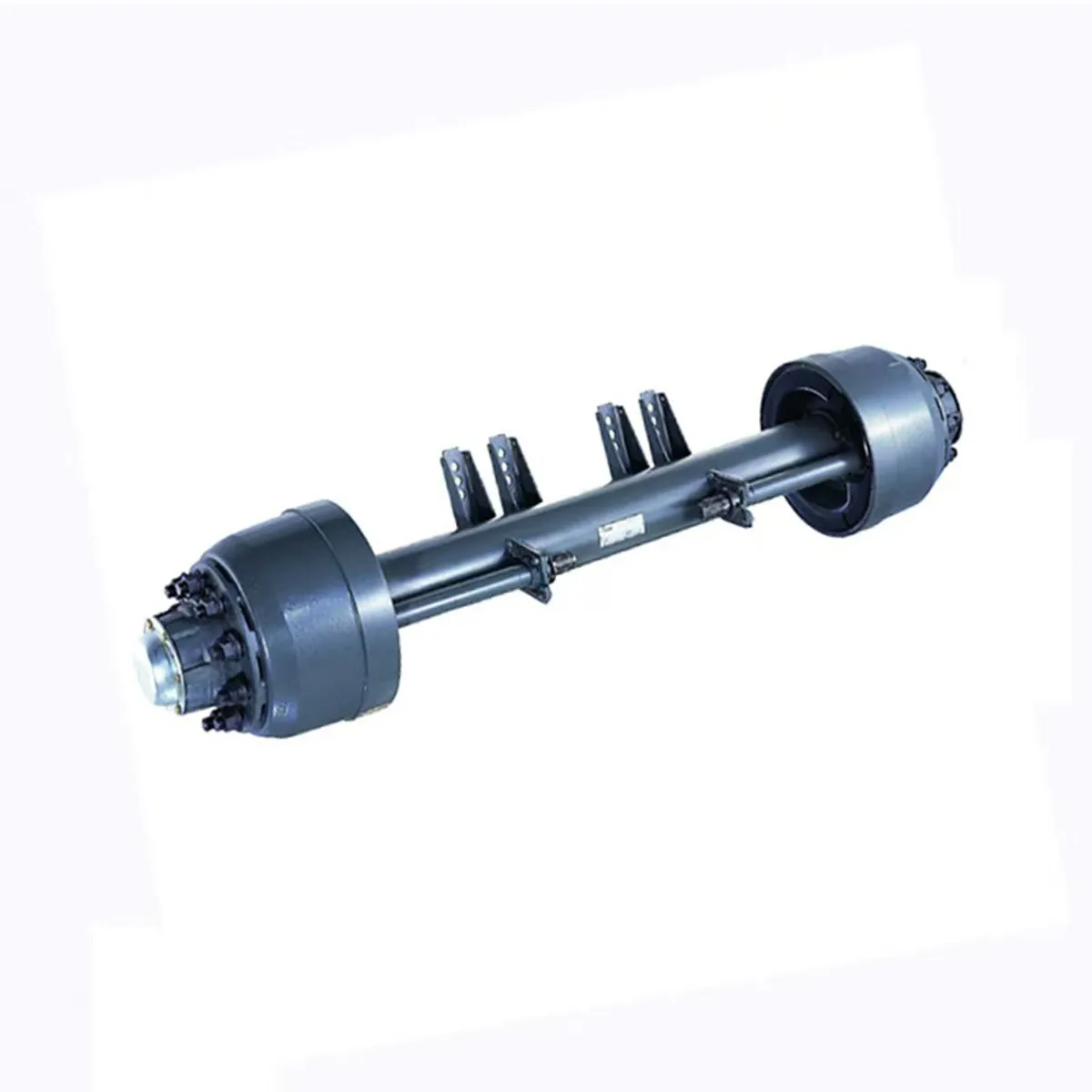
Specifications
| Capacity range | 13T, 14T, 16T, 20T single; 28T, 32T tandem sets |
|---|---|
| Beam material | 42CrMo forged alloy steel, quenched and tempered |
| Axle types | American type (wide seat, drum brake), German type (narrow, disc-ready), spoke axle (cast spoke hub) |
| Track / gauge width | 1955mm (77in) and 1800mm (71in), custom on request |
| Hub bolt pattern | 10-stud (widely used on 13T+) or 8-stud on lighter duty axles |
| Spindle finish | Ground and induction hardened, chrome-plated on request |
| Brake compatibility | Drum 420x180mm S-cam, or disc brake flange mount |
| Bearing type | Taper roller bearing, double row, pre-greased |
| Axle end | Welded flange-type or bolt-on brake spider, buyer's choice |
| Surface finish | Shot-blasted and powder coated, primer coat available for OEM paint |
American Type, German Type and Spoke Axle: How to Tell Them Apart
Most of the confusion we hear from first-time buyers comes down to which axle of trailer platform they actually need, because the three common designs look similar in a spec sheet but behave differently on the road. The American type axle uses a wide leaf spring seat and is built around drum brakes, which is why it dominates fleets in Africa, the Middle East and Latin America where drum linings are cheap to source and easy for a roadside workshop to service. The German type axle runs narrower, usually pairs with disc brake hardware, and shows up on trailers built to European running gear standards or exported into markets that copied that spec. The spoke axle is a different animal altogether: it uses a cast spoke hub instead of a stamped or forged flange hub, which gives it more surface area for heat dissipation and makes it the preferred choice for heavy tipper and construction trailers running in China and across Southeast Asia. We machine all three axle types on the same beam-forging line, so switching between them for an order is a spec change, not a new tooling cycle. We supply braked trailer axles as standard across all three types, and build to any configuration — a single trailer axle for straight platforms, dual trailer axles or tandem trailer axles for tridem and multi-axle running gear.
Picking the Right Trailer Axle Hub and Capacity
Undersizing an axle assembly is the single most common warranty claim we see referred to us from other suppliers, usually because a buyer matched the axle to the trailer's GVW instead of the actual per-axle load once cargo and tandem distribution are accounted for. A flatbed or lowbed running dense cargo like steel coil needs the full 13 ton trailer axle rating per position, while a tandem set on a tipper or bulk tanker is commonly specified at 16T or 20T per axle to leave margin for overload on rough roads. The trailer axle hub itself has to match both the wheel bolt pattern and the brake drum diameter you're running; a 10-stud hub with a 420x180 drum is the default across most of our export markets, but we also cut 8-stud hubs for lighter trailers and can bore to a customer-supplied pattern. Get the hub wrong and the wheel simply won't seat, so we ask every new buyer to send their current wheel spec or a rubbing of the bolt circle before we cut the first batch. We forge and machine axle hubs for trailers across all three axle types on the same production line, so a buyer standardizing hub patterns across a mixed American, German and spoke axle fleet isn't juggling separate hub suppliers. Ask for it as a hub for trailer axle or trailer axles and hubs together — either way the bore and bolt circle are cut to match on the same line.
Axle Assembly Compatibility with Suspension and Brakes
An axle assembly doesn't work in isolation, it has to sit correctly under the trailer suspension and line up with the brake actuation the trailer already runs. We build our beams to match the U-bolt spacing and spring seat height of the mechanical suspension setups most common in our export markets, so the axle drops into an existing leaf spring hanger without spacer plates. On the brake side, the spindle and camshaft bracket are machined to accept standard S-cam drum brake hardware or a disc caliper mount, and we size the brake chamber bracket to suit the slack adjuster stroke length so the technician setting up the brakes on arrival isn't fighting a mismatch. If a customer is replacing a single damaged axle rather than ordering a full running gear set, we ask for the suspension type and current brake chamber size up front, because that's what determines whether the replacement bolts straight in or needs a bracket adaptation.
Trailer Axle Replacement and Sourcing Spare Parts
Trailer axle replacement is usually driven by one of three things: a bent beam from overload or pothole impact, worn spindle bearings that have chewed through the race, or a fleet standardizing its running gear after years of mixed axle brands. Whatever the cause, the axle on a trailer is one of the few components that can't be patched around — a bent beam or a worn spindle has to be replaced outright, not shimmed or reinforced in the field. For a straight swap we recommend matching the existing track width and hub bolt pattern exactly rather than trying to upgrade capacity mid-fleet, since a wider or narrower axle changes the trailer's wheel-to-fender clearance and can affect how the wheels and rims sit under the mudguard. We stock the common spindle, hub and brake spider combinations as trailer axle parts for fast turnaround on single-unit replacement, and for fleets rebuilding several trailers at once we run full sets so every axle in the yard matches, which simplifies future parts stocking. Buyers doing their own rebuild should also check bearing preload and camshaft bushing wear before reusing an old hub on a new spindle, since mismatched wear parts are a common cause of early failure after a replacement. We list these as trailer axle components or trailer axles and parts in our export catalog, stocked for both single-unit swaps and fleet rebuilds.
Light-Duty Trailer Axles: 3500 lb to 8000 lb, Torsion and Drop Type
Alongside our heavy tandem and tridem running gear, we also build a lighter trailer axle line for utility, boat, and cargo trailers that never carry a container or bulk load — the segment most buyers mean when they search for a 3500 lb trailer axle or a 7000 lb trailer axle rather than a tonnes-rated semi trailer axle. These lighter axles ship as trailer axles with brakes, matched to a smaller drum and hydraulic or electric actuation, or as an unbraked idler axle for a boat or utility trailer that relies on the tow vehicle alone.
A torsion axle replaces the leaf spring and shackle assembly with a rubber-cushioned arm bolted directly to the axle tube, which is why torsion trailer axles ride quieter and flex independently at each wheel instead of the whole beam moving together the way a straight axle does. Buyers rebuilding a trailer originally fitted with a Dexter torsion axle can send us the axle tube diameter and arm spacing and we machine the axle tube and cushion to the same dimensions — described here as a compatible replacement, not an OEM Dexter part. We also cut a trailer drop axle option, where the spindle sits below the axle tube centerline to lower deck height on car haulers and low-profile utility trailers.
For a straight swap on a worn unit, tell us the capacity stamped on the old axle tag along with hub bolt pattern and whether brakes are fitted — a 3500 lb axle or 7000 lb axle without brakes uses a smaller idler hub than the braked version, so confirming brake fitment up front avoids a mismatched hub on arrival.
Working with a Trailer Axle Manufacturer on Custom Builds
Container chassis builders, tipper fabricators and fleet workshops each ask us for slightly different things, and as a trailer axle manufacturer running our own forging and machining lines in Liangshan, Shandong, we can hold a custom track width, hub pattern or brake spec without going through a trading company middleman. Typical custom requests include a non-standard bolt circle to match a customer's existing wheel stock, a longer spindle for extra hub width on wide-track trailers, or a specific paint spec to match an OEM's house color before the axle even reaches the trailer builder. Lead time on a standard 13T to 20T American or spoke axle in stock bolt patterns runs 15-20 days from deposit; custom hub patterns or non-standard track widths add roughly 10 days for new tooling. See our trailer axle selection guide for a full walkthrough of matching axle spec to trailer type before you place an order.
Frequently Asked Questions
What's the real difference between American type, German type and spoke axles?
How do I choose the right load capacity for my trailer axle?
Will your axle assembly fit my existing trailer suspension?
Can you make a trailer axle with a custom hub bolt pattern, and what's the MOQ and lead time?
Should I choose a welded axle end or a bolt-on brake spider?
What warranty do you offer on trailer axle assemblies?
Is a trailer axle with leaf springs the same as ordering leaf spring trailer axles separately?
What's the difference between axle replacement trailer parts and trailer axles for sale as a full running gear set?
Do you supply light-duty torsion axles, and is torsion axle replacement straightforward?
Tell us the part you need and your destination port — we'll send specs & a quote today.
Reply within 24 hours — or WhatsApp us at +86 199 5331 6215.