
Trailer Axle Types: How to Choose the Right Axle for Your Semi-Trailer
Choosing the correct trailer axle affects load capacity, tire wear, and downtime for the life of your semi-trailer. This guide walks through the main trailer axle types, american type trailer axle, german type trailer axle, and spoke type axle designs, along with capacity ratings, core components, and how to source a reliable axle for semi trailer builds or replacements.
Fleet buyers researching this topic in other markets often search under local terms such as essieu semi remorque in French-speaking regions or ось полуприцепа in Russian-speaking markets. The underlying engineering questions are the same everywhere.
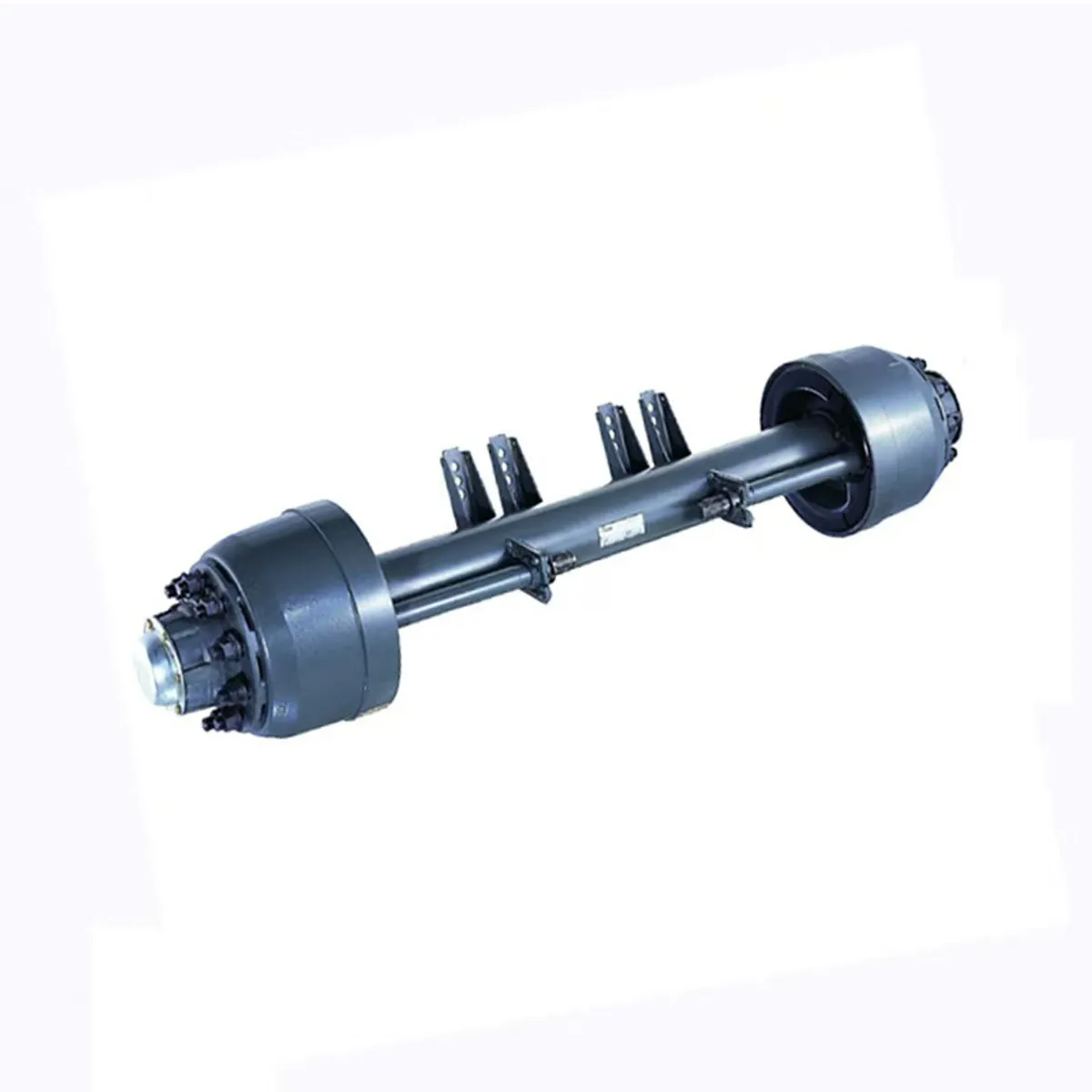
Trailer Axle Types: American, German, and Spoke Designs Explained
Every semi-trailer built today uses one of three basic trailer axle types, and understanding the different types of trailer axles before you order is the best way to avoid the single most common axle-buying mistake we see from new fleet operators and trailer builders. The three trailer axle types are the american type trailer axle, the german type trailer axle, and the older spoke type axle. Russian-speaking buyers researching виды осей полуприцепов (trailer axle types) online will find the same three-way split in every regional market.
The american type trailer axle uses a bolt-on flange hub and a round or square axle beam, and is the standard choice across North America and much of Latin America and Southeast Asia. It is simple to service in the field: the hub, drum, and bearings come apart with common tooling, and replacement trailer axles are widely interchangeable across brands.
The german type trailer axle, popularized by BPW and SAF in Europe, uses a welded taper-beam construction with a cambered profile that improves ride height under load and reduces stress at the spring seat. This is the dominant design across the EU, Russia, and much of the Middle East and North Africa. In Russian-speaking markets, buyers typically search for this component as ось полуприцепа or, when comparing brands, ось полуприцепа BPW specifically, since BPW-pattern axles have become something of a generic standard even for non-BPW manufacturers. Fleet buyers in France and francophone Africa use the equivalent term essieu remorque poids lourd when specifying heavy-duty trailer axles for tri-axle and quad-axle configurations.
The spoke type axle is the oldest of the three designs, using a cast or forged spoke hub rather than a solid flange. It remains in use on some flatbed, lowbed, and specialized heavy-haul trailers because the open spoke design sheds mud and debris better and allows for larger brake drums on the same axle beam diameter. It is less common on new production but still widely requested for repair and replacement work on older fleets.
In Spanish-language markets, all three fall under the general category tipos de ejes de remolque, and the axle itself, regardless of design family, is called eje semirremolque or, in general trailer contexts, eje para remolque. In Arabic-speaking markets, fleet managers search for محور نصف المقطورة (semi-trailer axle) or, when comparing the design families above, أنواع محاور نصف المقطورة, literally 'trailer axle types.' Buyers in the Gulf and North Africa commonly ask suppliers directly for محور المقطورة pricing across German-type and American-type options before committing to a fleet-wide spec.
For French-speaking buyers, the general term essieu semi remorque covers the same three families, and most RFQs we receive from West Africa and the Maghreb specify either an essieu BPW-pattern or essieu SAF-pattern axle by name, reflecting how deeply those two European brands have shaped the market vocabulary even where the actual axle is sourced from a different manufacturer.
Trailer Axle Capacity and Weight Rating: How to Choose the Right Axle
Once you've settled on a design family, the next question is capacity. Trailer axle capacity, also called trailer axle weight rating or trailer axle weight capacity, is specified per axle, not per trailer, and typically ranges from 9 tons on light flatbeds up to 16 tons or more on heavy low-loaders. That per-axle figure is what sets single axle trailer weight capacity, and a double axle trailer weight capacity is simply the sum of the two axles' ratings. Getting this number wrong either leaves capacity on the table (paying for axles you don't need) or puts you at risk of overload-related axle beam bending and premature bearing failure.
The most widely ordered rating worldwide is the 13 ton axle, which pairs well with tri-axle flatbed, tipper, and lowbed trailers built to a 40 to 60 ton gross combination weight. A tri-axle set of 13 ton axles gives roughly 39 tons of axle-group capacity, which comfortably covers most cross-border and domestic heavy haulage rules once you allow for the trailer's own tare weight.
So how to choose trailer axle capacity in practice? Start from the trailer's design GVW, divide by the number of axles, add a 10 to 15 percent safety margin for uneven load distribution, and round up to the next standard rating (9 / 11 / 13 / 16 tons). Don't just match the previous axle for semi trailer replacement without checking the actual duty cycle. Many fleets running overweight upgrade from 11 ton to 13 ton axles specifically to stop replacing bearings every season.
In Russian, this specification step is described as ось полуприцепа характеристики, the technical characteristics buyers request before quoting, covering load rating, track width, brake diameter, and stud pattern together, since ordering axle beam and hub separately from capacity data is a common source of mismatched deliveries. Likewise, when Russian buyers search ось для прицепа they are usually comparing capacity and bolt pattern across two or three suppliers before requesting samples.
Arabic-speaking buyers sourcing a full-capacity محور المقطورة for cross-border haulage in the GCC typically request the German-type taper-beam design at 13 to 16 ton ratings, since long-haul routes across Saudi Arabia and the wider Gulf favor the higher ride height and stronger camber of that design over the lighter american type trailer axle used on shorter regional routes.
Whichever rating you land on, always confirm the trailer axle weight rating against your trailer suspension rating too. An axle rated above its mounting suspension is a wasted upgrade, since the suspension becomes the real limiting factor.
Trailer Axle Assembly and Core Components
A trailer axle assembly is more than a bare beam; it's a complete system that needs to be quoted, shipped, and fitted as one unit. The core trailer axle parts in a standard assembly are the axle beam itself, the spindle at each end, the wheel hub, inner and outer bearings, the oil or grease seal, and the brake mounting bracket or spider.
The axle beam is the structural backbone: a forged or fabricated steel beam, cambered on german type trailer axle designs and straight on most american type trailer axle designs, that carries the full load from the spring seats down to the spindles. Beam failures are almost always fatigue cracks from long-term overload or a single hard impact, not manufacturing defects, which is why beam inspection is standard practice at every annual roadworthiness check.
The trailer axle spindle is the machined stub at each end of the beam that the hub and bearings ride on. Spindle diameter and thread spec have to match the hub bore and bearing bore exactly. This is the single most common fitment error we see in replacement orders, where a customer orders a hub or trailer axle bearing sized for a different spindle taper.
The axle hub for trailer use carries the wheel studs, the bearing races, and the brake drum or disc mounting face. Two hub styles dominate the market: hub-piloted (centered on the hub itself, common with disc wheels) and stud-piloted (centered on the wheel studs, common with the classic 10-stud pattern). We cover this distinction, along with wheel offset and torque specs, in our trailer wheel and rim guide.
The trailer axle bearing set, typically a tapered roller bearing pair, inner and outer, is the component that fails first under contamination or under-lubrication. In Russian, this part is called подшипник оси полуприцепа, and it's consistently one of the highest-volume spare parts we ship, since bearing replacement intervals are far shorter than axle beam life. The bearings ride inside the ступица оси полуприцепа (Russian for wheel hub), which is why Russian buyers usually order the bearing and hub together rather than separately, to guarantee a matched fit.
Finally, the trailer axle seal keeps grease in and water, dust, and road salt out of the hub cavity. A failed seal is the leading cause of premature trailer axle bearing failure: grease contamination from a worn seal will destroy even a brand-new bearing set within a few thousand kilometers. In French, the equivalent wear part is covered under roulement essieu remorque when specifying the full bearing-and-seal kit rather than the bearing alone.
Because all of these trailer axle parts interact, we always recommend ordering a matched trailer axle assembly rather than mixing beam, hub, and bearing from different suppliers. Tolerances stack up fast across three or four separate vendors.
How to Measure a Trailer Axle: Track Width, Spring Centers, and Spindle Specs
Knowing how to measure trailer axle dimensions correctly, sometimes searched simply as how to measure for trailer axle, is the difference between a replacement axle that bolts straight in and one that arrives close but not quite right. There is no single trailer axle diameter chart or trailer axle size chart that covers every brand and rating, which is exactly why measuring the beam directly matters more than looking up a table. Whether you're ordering a single replacement or specifying a new build, the same handful of measurements answer both how do you measure a trailer axle for one unit and how do you measure trailer axles across a whole fleet reorder.
Start with track width, the distance between the outer faces of the two hub mounting surfaces (or, on a dual-wheel setup, the distance between the centerlines of the inner and outer wheel positions on each side). Track width is measured hub face to hub face across the full beam, not spindle tip to spindle tip, since the hub face is what actually sets tire and wheel clearance against the chassis rails, mudguards, and adjacent axles. On most heavy-duty semi-trailers this falls in the 1800 to 2030mm range depending on axle brand and trailer width, and even a 20 to 30mm error here can cause tire rub against the frame or fenders.
Next, measure the spring center distance, meaning the distance between the two spring seats on the axle beam, measured center to center. This has to match your trailer's suspension hanger spacing exactly; there's no adjustment available once the axle is built, so getting spring center wrong on a reorder means the axle simply won't line up with the existing hanger brackets. If you're measuring an axle that's still mounted on the trailer, measure between the centerlines of the U-bolts or spring mounting pads rather than the outer edges of the spring pads themselves, since pad width varies between manufacturers even at the same nominal spring center spec.
Hub face to hub face, what most customers mean by how to measure trailer axle hub position, is the single most commonly requested dimension when a customer asks us how to measure an axle for a trailer over the phone, because it's the fastest way to confirm the beam length matches before you even get into bolt pattern or bearing specs, which is really what how to measure a trailer axle length comes down to in practice. Measure straight across the beam from the outer face of one hub to the outer face of the other, with the hubs mounted, not from bare spindle tip to spindle tip, since hub face position depends on the bearing setup and hub casting, not just the beam length.
Knowing how to measure trailer axle spindle diameter starts with two points: the bearing seat nearest the beam (where the inner bearing rides) and the bearing seat at the tip (where the outer bearing rides), since tapered spindles step down in diameter toward the end. Record both diameters along with the thread size and length on the outer end, since ordering a hub or trailer axle bearing set from spindle diameter alone, without confirming taper and thread spec, is one of the most common mismatches we see in replacement orders.
The brake flange, also called the backing plate or spider, mounts to the axle beam near each spindle and has its own diameter and bolt-hole spacing that must match your brake drum or disc caliper mounting. Measure the flange's outer diameter and the bolt circle diameter of the mounting holes separately, since two flanges can share the same outer diameter while using a completely different bolt pattern for the brake mounting itself.
Finally, confirm the wheel bolt circle, sometimes called the bolt pattern, which is the diameter of the circle formed by the wheel studs, combined with the stud count (commonly 10 studs on heavy-duty axles) and whether the wheel is stud-piloted or hub-piloted. A drum-mounted wheel setup and a hub-piloted disc wheel setup measure differently at this step: for a stud-piloted wheel, measure stud-to-stud across the bolt circle; for a hub-piloted wheel, measure the hub's pilot register diameter as well, since that diameter, not just the bolt circle, is what actually centers the wheel. We cover bolt pattern and pilot style in full detail in our trailer wheel and rim guide.
Fleets asking us how to measure for a trailer axle for a bulk reorder across multiple trailers should record all six of these dimensions, track width, spring center, hub face to hub face, spindle diameter (both seats plus thread), brake flange diameter and bolt circle, and wheel bolt pattern, for one representative axle per trailer model rather than assuming every axle on the yard is identical. Trailers built even a year or two apart from the same manufacturer sometimes ship with a different axle brand or spring center spacing after a supplier change, and reordering by trailer model alone without remeasuring is a common source of axles that arrive correct on paper but don't fit.
When to Replace: Trailer Axle Wear Signs and Repair
Trailer axle replacement is rarely about the axle beam wearing out; steel beams routinely outlast two or three brake and bearing rebuilds. The decision to replace instead of repair usually comes down to one of three findings: a cracked or bent axle beam, a spindle that's been damaged by a spun bearing, or corrosion that's eaten into the beam's structural section.
Routine trailer axle replacement work, swapping bearings, seals, brake shoes, and hub assemblies, is standard maintenance and shouldn't require touching the beam at all. Full replacement is worth it once you're past two or three bearing failures on the same spindle, since that usually signals the spindle itself has worn oversize and is no longer holding a proper bearing fit.
In Russian fleet terminology, this distinction matters: ремонт оси полуприцепа (trailer axle repair) covers bearing, seal, and brake work, while the decision to fully replace the ось полуприцепа is reserved for structural beam damage. Most Russian and CIS fleet workshops we work with keep a standing stock of bearing and seal kits precisely so that repair work stays routine and full-axle replacement stays rare.
Before any replacement job, inspect the mounting for the trailer brake system as well. A bent beam often shows up first as uneven brake drum wear or a brake chamber that's no longer square to the drum, which is a faster and cheaper warning sign than waiting for a full beam failure.
Sourcing Trailer Axles from a Manufacturer in China
China has become the default sourcing base for trailer axles worldwide, and for good reason: the same forging and CNC lines that supply OEM assembly plants in Shandong and Hebei also produce axles sold under BPW-pattern, SAF-pattern, and fully custom specifications for export. Working directly with an axle manufacturer China cuts out two or three layers of distributor margin compared to buying a branded European axle through a regional dealer.
When Russian buyers search купить ось полуприцепа, most are comparing exactly this trade-off: a genuine BPW or SAF axle at full brand price, versus a Chinese-made german type trailer axle built to the same beam profile, bearing bore, and bolt pattern at 30 to 40 percent lower landed cost. The ось полуприцепа цена difference is almost entirely brand markup, not material or machining quality, provided the manufacturer uses proper forged, not cast, beam stock and certified bearing brands.
For buyers who specifically want a BPW-compatible unit rather than a genuine BPW part, ось полуприцепа BPW searches typically lead to exactly this category: cross-reference axles matched to BPW's beam dimensions, stud pattern, and brake drum diameter, sold at a fraction of the OE price and fully interchangeable with BPW hubs and brake components.
In Spanish-speaking markets, the equivalent search is eje para remolque combined with a country of origin, and Latin American importers increasingly favor a direct axle manufacturer China relationship over buying pre-marked-up stock from a US or European reseller, particularly for fleets running american type trailer axle designs on flatbed and dry-van trailers.
Whatever your trailer axle types requirement, american, german, or spoke, request the full technical data sheet (beam profile, spindle diameter, bearing part numbers, bolt pattern, and brake compatibility) before ordering, and always ask for camber and toe-in tolerance on cambered german type trailer axle beams specifically, since this is the spec most often left off a basic price quote. See our full trailer axles range or browse related trailer parts for hubs, bearings, and seals sold separately.
Frequently Asked Questions
What is the difference between an american type trailer axle and a german type trailer axle?
What trailer axle capacity do I need for a tri-axle flatbed trailer?
What is included in a full trailer axle assembly?
How do I know if I need trailer axle replacement instead of a repair?
Is a spoke type axle still used on new trailers?
Can I buy a BPW-compatible axle from an axle manufacturer in China?
Why does a trailer axle seal fail, and what happens if I ignore it?
How do you measure a trailer axle for a direct replacement order?
How to measure an axle for a trailer if the old axle is too bent or damaged to measure directly?
How to measure for a trailer axle's wheel bolt pattern and pilot style?
Tell us the part you need and your destination port — we'll send specs & a quote today.
Reply within 24 hours — or WhatsApp us at +86 199 5331 6215.