
Semi Trailer Landing Gear — Two-Speed Legs
Landing gear is the pair of crank-operated legs that hold up the front of a semi trailer once it's uncoupled from the tractor, carrying the full static load through the kingpin end of the frame down to the ground. We build two-speed landing gear assemblies rated 24 to 28 tons, in inboard and outboard mount, with round foot or sand shoe options, matched to the same frame width and mounting bracket as the fifth wheel coupling and kingpin already on your trailer.
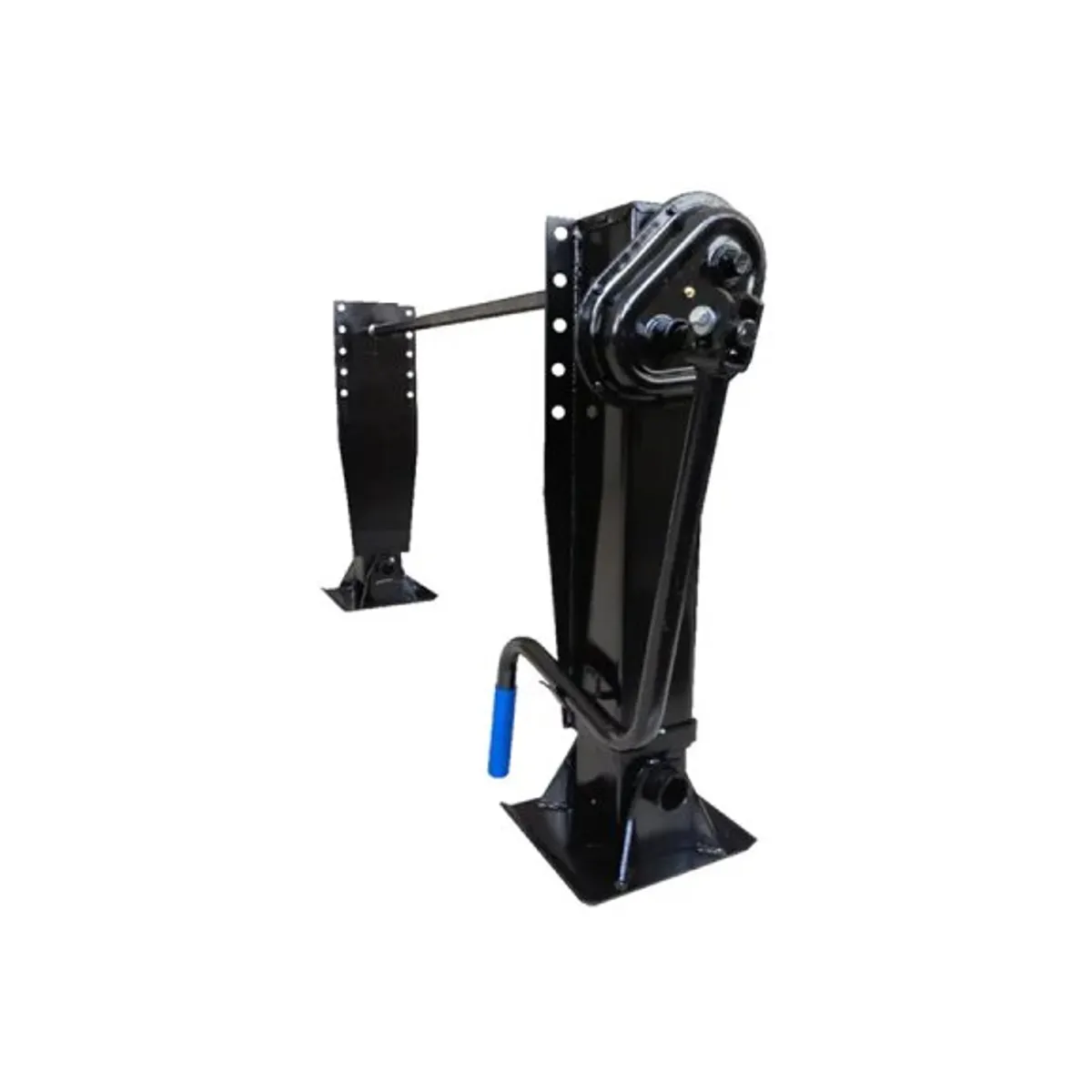
Specifications
| Static capacity | 12 ton – 28 ton (24,000 – 56,000 lb) |
|---|---|
| Gear type | Two-speed (high speed retract / low speed lift under load) |
| Mounting | Inboard (between frame rails) or outboard (outside frame rails) |
| Leg travel | 300 – 600 mm, telescoping inner/outer leg |
| Foot type | Round foot (hard standing) or sand shoe (soft ground) |
| Handle | Fold-away crank handle, side or front mount |
| Tube material | High-strength steel, welded box section |
| Finish | Primer + enamel or hot-dip galvanized |
Two-Speed Landing Gear — Why Two Gears Matter
Two-speed landing gear switches between a low gear ratio for lifting the full trailer weight off the fifth wheel and a high gear ratio for running the legs up and down quickly once they're off the ground. Cranking a loaded trailer up in high gear alone would take enormous handle effort or strip the gearbox, so the low-speed range multiplies torque at the cost of turns-per-inch, and the operator shifts to high speed only once the load is off the feet. Cheaper single-speed landing gear assemblies exist for light trailers, but any semi trailer landing gear rated above about 12 tons should be two-speed — trying to crank a loaded 24-28 ton leg with a single-speed gearbox is slow enough that drivers skip proper leveling, which accelerates wear on the legs and the fifth wheel plate both.
Inboard vs Outboard Landing Gear Mounting
Inboard landing gear mounts between the trailer's main frame rails, tucked up inside the chassis width — this is the more common layout on North American and many Asian trailers because the legs sit protected from side impacts and debris. Outboard landing gear mounts outside the frame rails, which some European and Middle East trailer builds favor because it clears space for cross-members and can give a wider, more stable footprint when the legs are extended. Neither layout is universally better; the choice comes down to what your trailer frame was built for; retrofitting outboard legs onto a frame drilled for inboard mounting (or the reverse) usually means new brackets rather than a straight bolt-in swap, so tell us your current mounting bracket dimensions when ordering a replacement landing gear assembly.
Sizing a 28 Ton Landing Gear
The static capacity stamped on a landing gear leg — commonly seen as 24 ton or 28 ton landing gear in the market — is the total weight the pair of legs can hold up when the trailer is parked and level, not a dynamic or towing rating. Match this to your trailer's actual gross weight rating rather than over-buying by default: a 28 ton landing gear costs more, weighs more, and has a larger footprint than a 24 ton unit, and running it on a lighter trailer just adds unsprung weight for no benefit. Where it matters is on tankers, flatbeds hauling steel or machinery, and heavy tandem or tri-axle trailers that regularly load close to their rated GVW — those trailers need the full 28 ton rating with margin, because a landing gear leg that's marginal on paper is the one that bends or buckles the first time the trailer sits nose-down on uneven ground.
Round Foot vs Sand Shoe
The standard round foot on a landing gear leg works fine on concrete yards, paved lots, and hard standing where the trailer is parked most of the time. A sand shoe — a flat, wider pad welded or pinned to the bottom of the leg — spreads the load over more surface area and keeps the leg from punching into soft ground, which matters for trailers that regularly drop and hook up on unpaved yards, construction sites, or dirt lots common across much of Africa and the Middle East. If your trailer spends time on anything other than sealed hard standing, spec the sand shoe from the start; retrofitting one later is straightforward but it's a detail worth locking in with your landing gear manufacturer at time of order rather than an afterthought.
Fitting and Maintaining a Landing Gear Assembly
Landing gear mounts to the trailer's chassis cross-member with a bolt-on bracket sized to the leg spacing and frame width — get the bracket dimensions wrong and the legs won't sit square, which puts uneven load on the gearbox and accelerates wear on one leg over the other. Grease the gearbox and telescoping leg tubes on a fixed schedule, check the crank handle folds and locks cleanly for road transport, and inspect welds at the bracket-to-frame joint for cracking, since that joint takes the full static load every time the trailer is dropped. See our landing gear guide for torque specs and a full inspection checklist by model.
Frequently Asked Questions
What's the difference between 24 ton and 28 ton landing gear?
Should I choose inboard or outboard landing gear mounting?
Why is two-speed landing gear better than single-speed?
Do I need a sand shoe or a standard round foot?
Can you supply a complete landing gear assembly to match our existing mounting bracket?
Is your landing gear the same as an electric trailer jack or camper jack stands?
Tell us the part you need and your destination port — we'll send specs & a quote today.
Reply within 24 hours — or WhatsApp us at +86 199 5331 6215.