
Trailer Landing Gear Guide: Types, Capacity & Maintenance
Landing gear looks like a simple pair of legs bolted under the trailer's A-frame, but the choice between mounting styles, gear ratios, and load capacity affects everything from how long a driver spends cranking at a drop yard to whether the legs are still straight after five years of gravel-lot use. This guide covers the landing gear types on the market today, how to size capacity correctly, and the maintenance routine that keeps a unit turning freely instead of seizing at the worst possible moment.
Landing Gear Types: Inboard vs Outboard Mounting
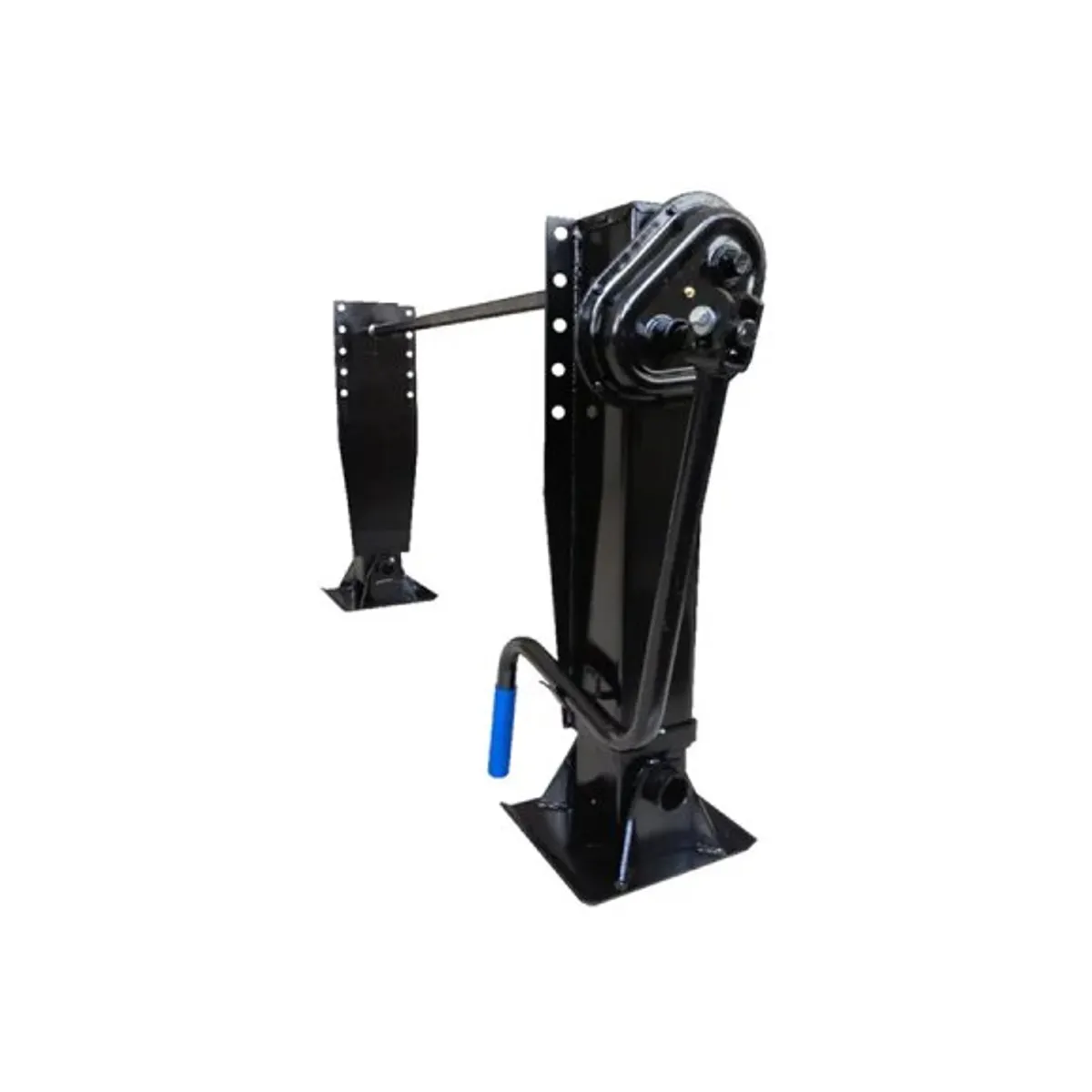
The first decision on any trailer build or replacement order is mounting style, and the two main landing gear types are not interchangeable without changing the mounting bracket. Outboard landing gear bolts or welds to the outside face of the trailer's main frame rails, with the legs extending down and slightly outward — this is the standard configuration on most North American flatbeds, dry vans, and export-market trailers we build for, because it keeps the gearbox and crank handle clear of anything mounted between the rails. Inboard landing gear mounts between the frame rails instead, common on some European chassis designs and on trailers where the rail spacing is narrower or where equipment under the frame would interfere with an outboard leg swing.
The practical difference shows up in two places: bracket geometry and leg clearance. An outboard unit needs a bracket that wraps the rail flange from outside; an inboard unit needs the opposite bracket profile and usually a narrower leg spread. Ordering the wrong inboard vs outboard landing gear configuration for an existing trailer means the bolt holes won't line up and the legs may not clear the rail at all, so always confirm mounting style against the trailer's existing bracket before placing a replacement order. If you're specifying landing gear for a new-build trailer alongside axles and suspension, outboard is the safer default unless the chassis design specifically calls for inboard clearance.
Russian-market buyers searching for опорное устройство полуприцеп or опорная стойка полуприцепа are almost always asking about this same outboard-mounted assembly, since it's the dominant configuration across CIS fleets as well. A semi trailer landing gear diagram showing both mounting styles side by side makes the bracket difference immediately obvious — outboard legs sit outside the rail flange with the crank handle facing out toward the shoulder of the trailer, while inboard legs sit tucked between the rails with the handle typically facing the centerline, which is also why inboard units are harder to crank from outside the trailer on a tight yard.
Single Speed vs Two Speed Landing Gear
Landing gear also splits by gearbox type. Single speed units turn the leg screw at one fixed ratio for every crank rotation — simple, cheap, and adequate on light trailers where the legs are only supporting a partially loaded chassis. Two speed landing gear gives the driver a high gear for running the legs up and down quickly when there's little weight on them, and a low gear that trades crank speed for mechanical advantage once the legs are actually bearing the trailer's weight during coupling and uncoupling.
On anything over roughly 20,000 kg gross trailer weight, two speed is worth the added cost — a single speed unit under real load can take two to three times as many crank turns and noticeably more arm effort to raise the legs the final few inches, which adds up across a driver's shift and accelerates wear on the gearbox teeth from the sustained torque. High-capacity flatbeds and tank trailers we supply landing gear for are almost always ordered in two speed configuration for exactly this reason.
This is the same component French-speaking buyers refer to as béquille semi remorque or pied de support remorque, Spanish-speaking buyers as pata de apoyo semirremolque or gato de apoyo, and Portuguese-speaking buyers as perna de apoio semirreboque or patola reboque — the gear-ratio distinction applies across every market regardless of naming convention.
Sizing Landing Gear Capacity Correctly
Landing gear capacity is rated for the static and dynamic load the legs carry when the trailer is uncoupled and resting on them — not the trailer's full GVW while it's hitched and rolling on its axles. Buyers sometimes size landing gear off the tractor's towing capacity or the trailer's total payload rating, which overstates what the legs actually need to hold, or in the opposite mistake, size off an empty trailer weight and end up with legs that bend the first time the trailer is dropped fully loaded at a distribution yard.
The correct figure is the trailer's gross weight distributed onto the landing gear footprint when uncoupled — for most tandem-axle semi-trailers that's a static capacity in the 20,000–28,000 kg range, with heavier flatbeds and lowbeds sometimes specifying beyond that. We size landing gear to match the customer's stated gross trailer weight plus a safety margin for uneven yard surfaces and repeated drop-and-hook cycles, the same way we size leaf springs to the axle load rather than the tractor rating. If you're not certain of your trailer's uncoupled resting weight, send us the GVW and axle configuration and we'll confirm the right capacity rather than guessing from the tractor spec. Buyers searching for trailer jack capacity or trailer jack weight capacity are usually asking the same question under landing gear's everyday name — the uncoupled static rating above is exactly what those terms mean.
Landing Gear Maintenance and the Crank Handle
Landing gear maintenance is short on steps but easy to skip, and skipping it is what turns a smooth-cranking unit into one that needs a cheater bar within two years. The gearbox housing has a grease fitting that should be serviced at every scheduled maintenance interval — dry gear teeth inside the box wear faster and eventually strip, at which point the whole gearbox needs replacement rather than a simple lubrication fix. The leg shaft itself should be wiped down and inspected for bends or scoring, since a bent shaft binds inside its housing and makes cranking difficult even with fresh grease. The foot pivot at the bottom of the leg also needs periodic grease and a check that the pivot pin hasn't worn oval, which causes the foot to sit crooked on uneven ground.
The landing gear crank handle itself is usually the first symptom of neglected maintenance — a handle that used to turn with two fingers and now needs both hands and body weight is telling you the gearbox is dry or the shaft is binding, not that the unit needs replacing outright. Catching that early with a grease service is far cheaper than replacing a seized gearbox. We stock crank handles and gearbox assemblies separately for exactly this reason, so a fleet doesn't have to replace an entire leg assembly over a worn handle or a gearbox that's simply overdue for grease.
Fleets sometimes go looking for a formal landing gear maintenance manual the way they'd look up a service schedule for any other drivetrain component, and while manufacturers don't usually publish a standalone book for it, the maintenance manual for trailer landing gear really does boil down to the three steps above at every scheduled interval, plus a visual check of the mounting bolts for looseness. That's worth saying explicitly because a Boeing 737 landing gear maintenance manual governing aircraft undercarriage servicing runs to hundreds of pages covering hydraulic retraction systems, torque-limited fasteners, and FAA-mandated inspection intervals — trailer landing gear maintenance shares nothing with that document beyond the name. There's no hydraulics, no retraction mechanism, and no certifying authority involved; it's grease, inspect, and crank-test. The same simple routine applies whether a fleet calls it 5th wheel landing gear maintenance because the trailer couples to a fifth wheel, or just landing gear service — what's hitched at the kingpin end has no bearing on how the legs at the A-frame end need to be greased and inspected.
Landing Gear Installation Basics
Landing gear installation starts with confirming mounting type against the trailer frame — outboard brackets and inboard brackets are not interchangeable, as covered above, and the bracket has to match the frame rail height and flange width exactly or the legs won't hang level. Bolt-on brackets are the more common field-installation format since they don't require welding on the chassis; weld-on brackets are typically fitted during new-trailer fabrication where the trailer builder controls weld quality on structural steel.
Once the bracket is mounted, the legs need to be checked for level and square before final tightening — legs installed slightly out of square bind under load even when everything is torqued to spec, which shows up later as hard cranking that looks like a maintenance problem but is actually an installation error. For a full replacement, we recommend ordering landing gear as a matched set with the correct bracket, gearbox ratio, and capacity rating confirmed against the trailer spec before the parts ship, rather than sourcing legs and brackets separately from different suppliers. How to replace trailer landing gear follows the same steps as a new-build fit: confirm mounting type, match the bracket to the frame, and check the legs for level and square before final tightening.
Frequently Asked Questions
What's the difference between inboard and outboard landing gear?
Is two speed landing gear worth the extra cost?
How do I know what landing gear capacity I need?
How often should landing gear be greased?
Why is my landing gear crank handle suddenly hard to turn?
What are the different types of trailer jacks?
Tell us the part you need and your destination port — we'll send specs & a quote today.
Reply within 24 hours — or WhatsApp us at +86 199 5331 6215.