
Trailer Suspension Systems & Suspension Parts
We build complete semi trailer suspension assemblies for single, tandem and tridem axle configurations - mechanical leaf spring, bogie balance-beam and air bag trailer suspension systems, sized from 13T to 16T per axle. Every tandem trailer suspension or tridem assembly ships with hanger brackets, equalizer beams, suspension U-bolts and bushings matched to your axle spacing, so it bolts straight onto the chassis without on-site fabrication.
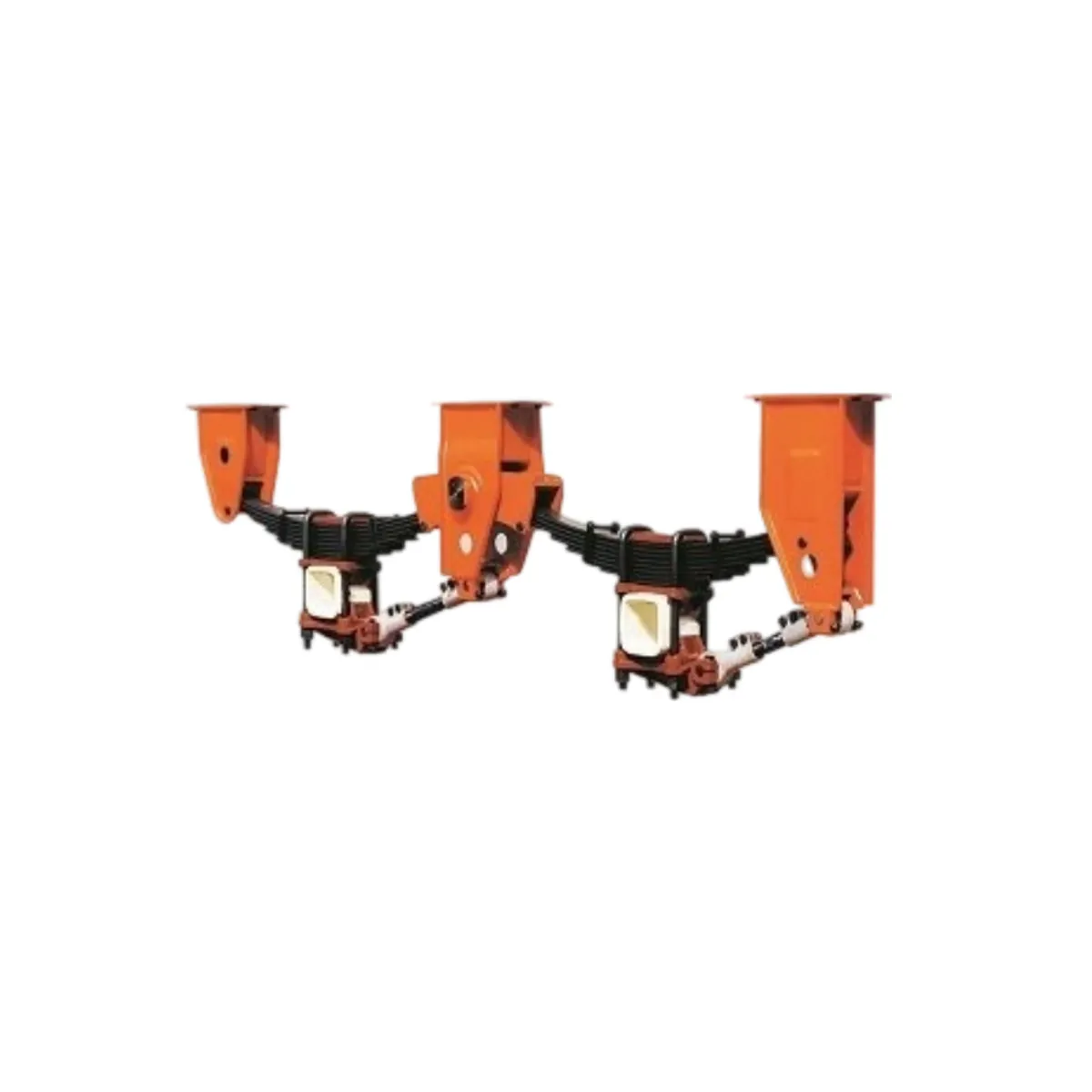
Specifications
| Suspension type | Mechanical leaf spring / Bogie balance beam / Air bag |
|---|---|
| Capacity per axle | 13T, 14T, 16T |
| Tandem/tridem capacity | 26T - 32T (2 or 3 axles) |
| Spring type | Parabolic (2-3 leaf) or multi-leaf (7-9 leaf) |
| Axle spacing | 1300mm / 1350mm / 1400mm (custom on request) |
| Hanger bracket material | Cast steel or welded steel plate |
| Bushing type | Rubber bushing or maintenance-free composite |
| U-bolt spec | M20-M24, grade 8.8, zinc or hot-dip galvanized |
| Air spring travel | 150mm - 200mm with height control valve |
| Coating | Shot-blast + primer + top coat, or hot-dip galvanized |
Mechanical Suspension vs Bogie Suspension vs Air Suspension
Mechanical suspension - a leaf spring stack clamped to the axle with suspension u bolts and pinned into fixed hanger brackets - is the design most fleets in Africa, Latin America and the Middle East run, because it has almost nothing to fail. There's no air line to puncture, no compressor to fail, and a cracked leaf can be swapped roadside with a jack and a wrench. Parabolic springs (2-3 thick tapered leaves) ride softer and weigh less than multi-leaf packs, but multi-leaf stacks are cheaper to source and more tolerant of overload on rough roads, which is why they still dominate on trailer leaf spring orders for flatbed and tipper trailers.
Bogie suspension - sometimes called rocker roller suspension because the balance beam rocks on its center pivot as the axles roll over uneven ground - is the mechanical layout used on tandem and tridem trailers: instead of each axle springing independently, a balance beam (equalizer beam) pivots on a center bushing and lets the two or three axles share load as the trailer crosses uneven ground. Without that beam, one axle takes most of the shock on any dip and the tires wear unevenly. Bogie suspension is standard on heavy tipper, lowbed and flatbed trailers running 26T-32T combined axle loads, and it's built around the same hanger brackets, torque arms and U-bolts as single-axle mechanical suspension, just doubled or tripled up along the beam.
Air suspension replaces the leaf spring with a rubber bellows (air bag) sitting on a trailing arm, fed by a height control valve that keeps the chassis level regardless of load. We supply air bags for trailer suspension as complete airbag trailer suspension kits - bags, trailing arms, height control valve and hanger brackets matched as one set - rather than a bag on its own that a workshop then has to match to brackets from a different supplier. Trailer air bag suspension gives a noticeably softer ride and protects cargo from vibration, which is why it's the default on reefer and tank trailers hauling temperature-sensitive or liquid loads. The tradeoff is cost and complexity - air lines, valves and bags need periodic inspection and aren't something a roadside mechanic in a remote area can improvise a fix for, so most of our air suspension orders go to fleets running on-highway routes with access to service depots. Fleets researching air suspension for trailer applications are usually weighing exactly this tradeoff - an air ride trailer suspension costs more up front and needs more service infrastructure, but it's the only option that keeps chassis height constant from empty to fully loaded.
Smaller single-axle utility and boat trailers sometimes use a rubber suspension torsion beam instead of a leaf spring - a sealed axle tube with rubber cords that twist to absorb bumps, needing no grease points or shackles at all. It isn't part of the 13T+ semi-trailer range on this page, but we build torsion bar suspension trailer axles and torsion axle suspension kits on our light and utility trailer line - sealed, maintenance-free, and sized for boat, cargo and single-axle trailers under about 3.5T where a leaf pack would be overkill. At the other end of the spectrum, off-road and rough-terrain trailers sometimes specify long travel suspension - more wheel travel than a standard highway leaf pack allows - which we can build into a custom air suspension or heavy-duty parabolic spec on request.
Suspension Assembly Components
A complete suspension assembly is more than the spring itself. A trailer leaf spring hanger bolts or welds to the chassis rail and carries the front and rear spring eyes - we supply it individually or as a trailer leaf spring hanger kit with U-bolts and bushings included; on bogie setups, a center bracket also carries the balance beam pivot bushing. Hanger style varies by suspension type too: a rigid mechanical hanger differs from the isolation spring hangers used where rubber-isolated mounts cut road noise, and from the variable spring hanger designs that let ride height be fine-tuned on air suspension; on air-ride builds we also fit an air hose spring hanger with an integrated bracket so the air line doesn't chafe against the frame rail. Equalizer beams (also called walking beams, and the whole layout a walking beam axle or trailer walking beam suspension) sit between tandem or tridem axles and transfer load through a heavy pivot bushing - we machine these from forged or cast steel and press in either rubber or maintenance-free polymer bushings, the same truck suspension bushings used across our hanger and equalizer builds, depending on how much roadside grease access the customer's routes actually allow. Torque arms, sometimes called radius rods or a trailer torque arm, resist axle windup under braking and acceleration and are standard on both mechanical and air suspension builds - we machine them as direct cross-reference replacements for Hendrickson trailer suspension parts as well as our own equalizer-beam builds.
U-bolts clamp the spring pack to the axle seat and are the single most commonly replaced suspension part in the field - we supply them in grade 8.8 steel, sized to axle diameter and spring pack height, with the full nut and washer kit. See our U-bolts & fasteners range for standalone reorders. Spring pins and suspension shackles let the rear spring eye slide slightly as the spring flexes under load; worn shackle bushings are the most common cause of a trailer that wanders or clunks over bumps, and they're a five-minute swap with the right press tool. A multi-leaf leaf spring suspension trailer build stays the most common spec on rough-road routes precisely because every one of these parts - spring, U-bolt, shackle - can be swapped roadside without special tooling.
Matching Suspension to Axle Type and Load
Suspension can't be specified in isolation from the axle it hangs on - spring seat width, U-bolt spacing and hanger bracket dimensions all have to match the trailer axle you're running, whether that's a straight beam axle rated 13T or a heavier 16T unit for tridem tippers. We build to your existing axle spacing (1300mm, 1350mm or 1400mm are the common centers) so a suspension assembly retrofits onto an existing chassis without cutting and re-drilling frame rails. For tandem and tridem groups, we also match wheel offset to the wheels and rims already on the trailer so the bogie doesn't need new hub spacing to clear the tires.
Overloading is the single biggest killer of suspension components in the markets we ship to - a leaf spring rated for 13T that regularly carries 15-16T will crack at the eye or center bolt within months, not years. When a customer sends us their typical loaded weight rather than just the trailer's nameplate rating, we can spec a spring pack or air bag with enough margin to survive real-world overload without over-speccing (and overpricing) the whole assembly.
Retrofitting and Upgrading Existing Trailers
Most of our suspension orders aren't for new-build trailers - they're fleets replacing a suspension assembly that's cracked, sagged or simply worn out on a trailer that still has years of chassis life left. Converting a multi-leaf mechanical suspension to parabolic springs on the same hanger brackets is a common upgrade that cuts unsprung weight and improves ride without touching the frame. Converting mechanical to air suspension is more involved - it usually requires new hanger brackets and trailing arms sized for the air bag geometry, plus routing air lines and mounting a height control valve, so we spec that as a full assembly rather than a drop-in part swap.
For bogie conversions - adding a third axle to an existing tandem trailer, for example - the balance beam length and pivot bushing size have to be recalculated for the new combined load and axle spacing, not just copied from the existing two-axle beam. We ask for chassis rail dimensions and the target GVW before quoting so the beam geometry actually balances load across all three axles rather than concentrating wear on one.
Frequently Asked Questions
Should I choose mechanical or air suspension for my trailer?
What is bogie suspension and when do I need it?
Will a replacement suspension assembly fit my existing axle spacing?
How often does trailer suspension need maintenance?
Can I retrofit air suspension onto a trailer that currently has mechanical leaf springs?
Are your suspension parts compatible with Hendrickson trailer axles?
Can you supply replacement bushings for a Hendrickson Intraax bogie?
Tell us the part you need and your destination port — we'll send specs & a quote today.
Reply within 24 hours — or WhatsApp us at +86 199 5331 6215.