
Trailer Suspension Types: Mechanical vs Air Suspension Explained
The suspension choice on a semi-trailer affects ride height, load distribution across axles, tire wear, and cargo protection just as much as the axle rating does. This guide covers the main trailer suspension types, how trailer suspension works, the mechanical suspension vs air suspension decision, and the core trailer suspension parts you need to keep on hand for maintenance.
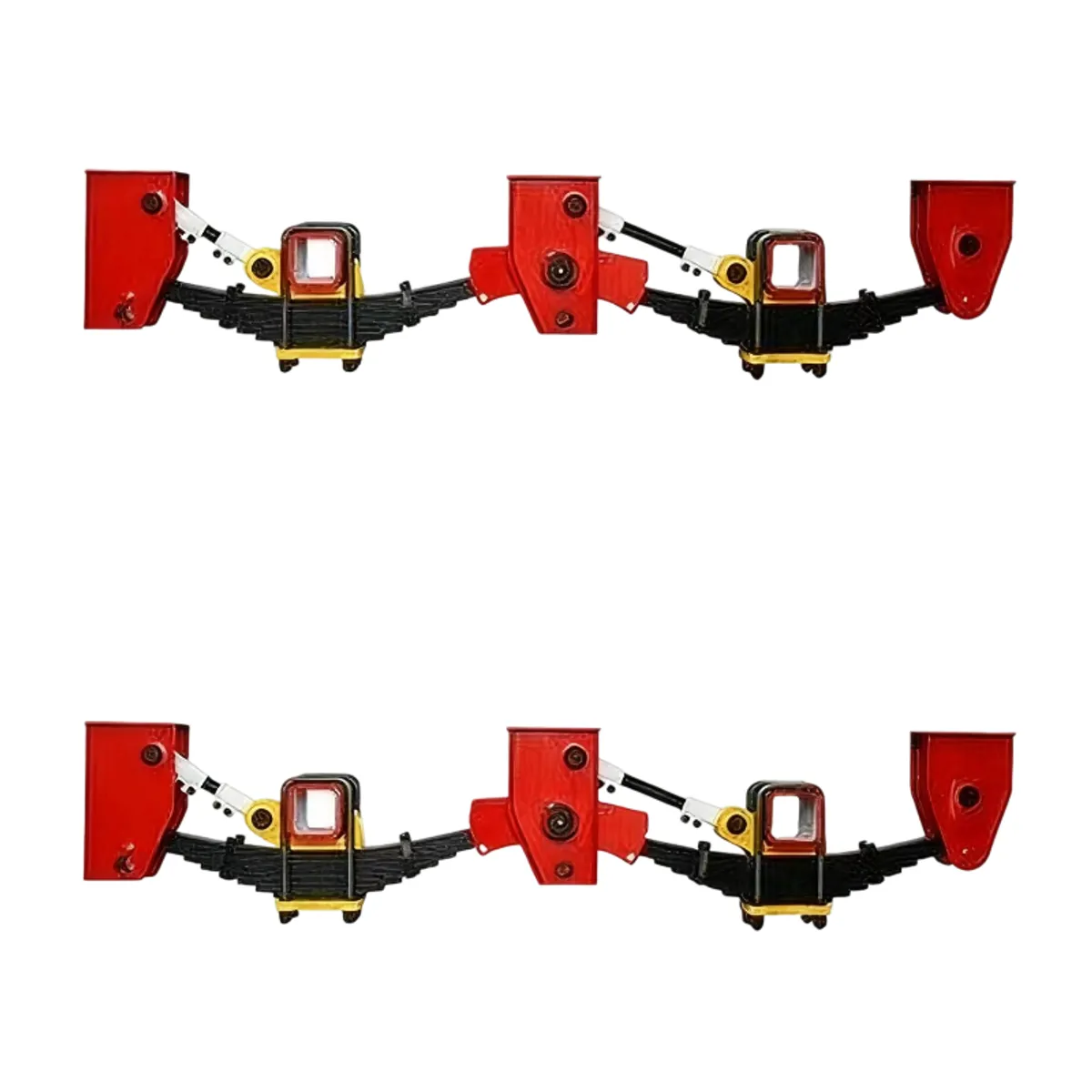
How Trailer Suspension Works: An Overview of Trailer Suspension Types
How trailer suspension works is easy to state and harder to get right in practice: the suspension has to carry the trailer's load, transfer that load evenly to every axle in a multi-axle group, absorb road shock, and keep the tires in consistent contact with the road surface across empty, partially loaded, and fully loaded conditions. Every trailer suspension types on the market today is built to solve that same problem with a different trade-off between cost, ride quality, and maintenance simplicity.
Broadly, trailer suspension types fall into two families. Mechanical suspension uses steel components, leaf springs, bogie beams, or walking beams, to carry and distribute the load, and remains the standard on flatbed, tipper, lowbed, and general cargo trailers worldwide because it's simple, cheap, and very tolerant of rough or unpaved roads. Air ride suspension replaces the steel spring with an air bag, giving a smoother ride and adjustable ride height at a higher parts and maintenance cost. The mechanical suspension vs air suspension decision is one of the first specs a buyer needs to lock down, since it affects the axle mounting, brake chamber bracketry, and even the trailer's overall chassis design, not just the ride. Buyers searching for the types of trailer suspension systems available, or simply trying to compare the different types of trailer suspension before writing a spec sheet, are really asking this same mechanical-versus-air question, whatever the exact search phrase.
In Russian, the general term for this whole product category is подвеска полуприцепа, and Russian-speaking buyers researching options typically want to compare a рессорная подвеска (leaf spring suspension) against a пневматическая подвеска полуприцепа (air suspension) before specifying a new trailer or a suspension swap on an older one. French-speaking buyers use suspension semi remorque as the general search term, Spanish-speaking buyers use suspensión semirremolque, and Portuguese-speaking buyers use suspensão semirreboque, all covering the same mechanical-versus-air choice described above.
Arabic-speaking fleet buyers researching تعليق نصف المقطورة (trailer suspension) in Gulf and North African markets tend to favor mechanical designs for cross-desert and unpaved-route haulage, reserving air suspension for on-highway tanker and reefer fleets running mostly paved corridors. Whatever the market, start the suspension conversation from the trailer's actual duty cycle and cargo type, not just the axle rating, since two trailers with identical trailer axles can need very different suspension specs.
Mechanical Suspension: Leaf Spring, Bogie, and Walking Beam Designs
Leaf spring suspension is the oldest and still the most common mechanical design: a stack of curved steel leaves, clamped together and mounted between the axle and the trailer frame, that flexes to absorb load and road shock. It's inexpensive, easy to repair with basic tooling, and forgiving of overload conditions that would damage an air bag outright, which is why it remains the default choice for flatbed, general cargo, and tipper trailers across most of the world.
Bogie suspension refers to a tandem or tri-axle mechanical arrangement where two or three axles share a common leaf spring or beam structure, equalizing load between the axles as the trailer moves over uneven ground. Without this equalization, one axle in a group could carry significantly more load than its neighbors on rough terrain, accelerating tire and bearing wear on the overloaded axle. Bogie suspension is standard on multi-axle flatbed, lowbed, and tipper trailers built for off-highway or mixed-surface work.
Walking beam suspension takes the load-equalizing idea further: each side of the bogie pivots on a central beam (the 'walking beam'), letting one axle rise while the other drops as the trailer crosses a bump or dip, keeping both axles loaded evenly even on badly rutted roads. This design is especially common on heavy-haul and off-road trailers in mining, logging, and construction haulage, where load equalization under extreme terrain matters more than ride comfort.
In Russian, leaf spring suspension is called рессорная подвеска, and the bogie/walking-beam equalizing design is called балансирная подвеска, a term Russian and CIS fleet buyers use specifically when comparing multi-axle load-equalization systems for off-highway and construction haulage. In French, this whole mechanical category is suspension mécanique remorque; in Spanish, suspensión mecánica; and in Portuguese, suspensão mecânica, each covering leaf spring, bogie, and walking beam designs together.
Arabic-speaking buyers specifying تعليق ميكانيكي (mechanical suspension) for construction and mining haulage in North Africa and the Gulf typically request the walking beam or bogie configuration specifically, since standard leaf spring suspension without load equalization wears unevenly on the rough haul roads common to those sectors. Browse our trailer leaf springs range for parts across all three mechanical designs.
Leaf spring suspension also splits by mounting orientation, a separate question from the bogie or walking beam choice above. In an overslung mounting, the leaf spring sits on top of the axle beam, which is the standard arrangement on most flatbed, tipper, and general cargo semi-trailers because it maximizes ground clearance under the axle. In an underslung mounting, the spring sits below the axle beam instead, lowering the trailer's ride height and center of gravity at the cost of some ground clearance. The overslung vs underslung suspension choice matters most on lighter trailers where ride height affects loading convenience or towing stability more than clearance: box trailers, car trailers, and, most commonly, caravans almost always run underslung leaf springs to keep the floor low and the towing profile stable, which is why questions about the types of caravan suspension usually lead straight to an underslung leaf spring answer rather than any of the heavier bogie or walking beam designs covered above. Heavy semi-trailer axles, by contrast, are built almost universally overslung, since the extra ground clearance matters more than the small stability gain from a lower spring position at highway weights.
Air Ride Suspension: How It Works and When to Choose It
Air ride suspension replaces the steel leaf spring with a rubber air bag (bellows) mounted between the axle and frame, connected to an onboard air supply and controlled by a height control valve that adjusts bag pressure to keep ride height constant across empty and loaded conditions. This active height control is the main functional difference in the mechanical suspension vs air suspension comparison: a leaf spring compresses more as load increases, while an air bag maintains a near-constant ride height by adding air pressure as load goes up.
The practical benefits of air ride suspension are a noticeably smoother ride, less transmitted road shock to sensitive cargo, and the ability to raise or lower the trailer for loading dock height matching or coupling clearance. These benefits matter most for reefer trailers, tankers hauling liquids sensitive to agitation, and general freight running mostly on paved highway, which is why air suspension has become the default spec across Western Europe and increasingly common on premium long-haul fleets elsewhere.
The trade-offs are real, though: air bags, height control valves, and the associated air lines add cost and add failure points compared to a leaf spring, and air suspension is generally less tolerant of overload and off-road conditions than a well-specified mechanical bogie or walking beam setup.
In Russian, air ride suspension is пневматическая подвеска полуприцепа, a term increasingly common in RFQs from fleets running international EU-bound freight where air suspension is close to mandatory for certain cargo types. In French, the term is suspension pneumatique remorque; in Spanish, suspensión neumática remolque; and in Portuguese, suspensão pneumática reboque. Arabic-speaking buyers researching تعليق هوائي (air suspension) for GCC on-highway tanker and reefer fleets should confirm air bag part compatibility with their existing compressor and reservoir capacity before switching a mechanical fleet over to air ride.
It's worth distinguishing the trailer-side air suspension covered in this section from air suspension fitted to the tow vehicle itself, since the two get confused in buyer questions about lighter trailers. Half-ton and heavy-duty pickups increasingly ship with their own factory air suspension — a Ram 1500 air suspension setup, for example, self-levels the truck's rear ride height under load — and that tow-vehicle air suspension interacts with towing hardware in its own right. A Ram 1500 air suspension weight distribution hitch setup still needs properly tensioned spring bars to control trailer tongue weight and sway, because the truck's self-leveling air suspension corrects ride height after the load is already on, rather than resisting sway or transferring tongue weight forward the way a weight-distribution hitch does. That's a tow-vehicle-side question separate from anything in the trailer suspension types covered in this guide, but it comes up often enough in questions about lighter trailers that it's worth flagging here. The same logic applies to any weight distribution hitch with air suspension on the tow vehicle, regardless of make — spring bars still do the sway-control and tongue-weight job that self-leveling air suspension does not replace.
Core Trailer Suspension Parts
Regardless of design family, a working suspension system depends on a handful of trailer suspension parts that need to be sourced and replaced as a set, not individually swapped without checking the rest. On a mechanical leaf spring suspension, the core parts are the leaf spring pack itself, the rubber bushings at each mounting eye, the U-bolts that clamp the spring to the axle, and the shackle that lets the spring flex under load. On a bogie or walking beam setup, add the equalizer beam, its center pivot bushing, and the torque rods that keep the axles located fore-and-aft under braking and acceleration.
On air ride suspension, the core trailer suspension parts are the air bags themselves, the height control valve, the air lines and fittings, the trailing arm that locates the axle, and a shock absorber at each wheel end, since air suspension always needs a separate damper the way a leaf spring's own friction does not.
A semi trailer suspension diagram — or semi trailer suspension parts diagram — showing these components together makes it easier to confirm which part is worn before ordering a replacement.
Ordering these trailer suspension parts as a matched kit, rather than piecing together bushings from one supplier and springs from another, avoids the tolerance mismatches that show up as premature bushing wear or an uneven ride height within the first few months of use.
Trailer Suspension Maintenance Checklist
Suspension maintenance on a mechanical system means checking leaf spring bushings and shackles for wear, inspecting U-bolts for proper torque, and looking for cracked or shifted leaves at every scheduled service. Bushings are almost always the first component to fail, since the constant flexing under load wears the rubber long before the steel spring itself shows fatigue.
On air ride suspension, suspension maintenance focuses on the air bags (checking for cracks, chafing, or slow leaks), the height control valve linkage (which can seize or slip out of adjustment), and the shock absorbers, which wear out faster on air suspension than on a comparable leaf spring setup since they're doing more of the damping work.
Whichever design your fleet runs, build suspension maintenance into the same interval as your trailer axle and brake system checks, since a worn suspension bushing or a slow air leak often shows up first as uneven tire wear or a brake that drags on one side, long before the suspension component itself visibly fails.
Frequently Asked Questions
What are the main trailer suspension types available today?
Mechanical suspension vs air suspension: which should I choose?
What is bogie suspension and where is it used?
How does walking beam suspension differ from standard bogie suspension?
Which trailer suspension parts wear out first?
How often does trailer suspension maintenance need to be done?
Tell us the part you need and your destination port — we'll send specs & a quote today.
Reply within 24 hours — or WhatsApp us at +86 199 5331 6215.