
Slack Adjusters — Automatic & Manual, Haldex-Style Fitment
The slack adjuster is the lever between the brake chamber and the S-camshaft, and it is also the part most often ignored until a brake fails an inspection. Sigma builds automatic and manual slack adjusters for trailer axles in the spline counts and arm lengths that match BPW, SAF, Fuwa, York, and Haldex-equivalent hardware, so a fleet replacing one arm gets a part that restores full stroke — not one that just bolts on. On a parts list, the same component shows up under several names — trailer slack adjuster, slack adjuster trailer stock, slack adjuster on trailer brake systems, or slack adjuster truck parts — all pointing to the one lever assembly described below.
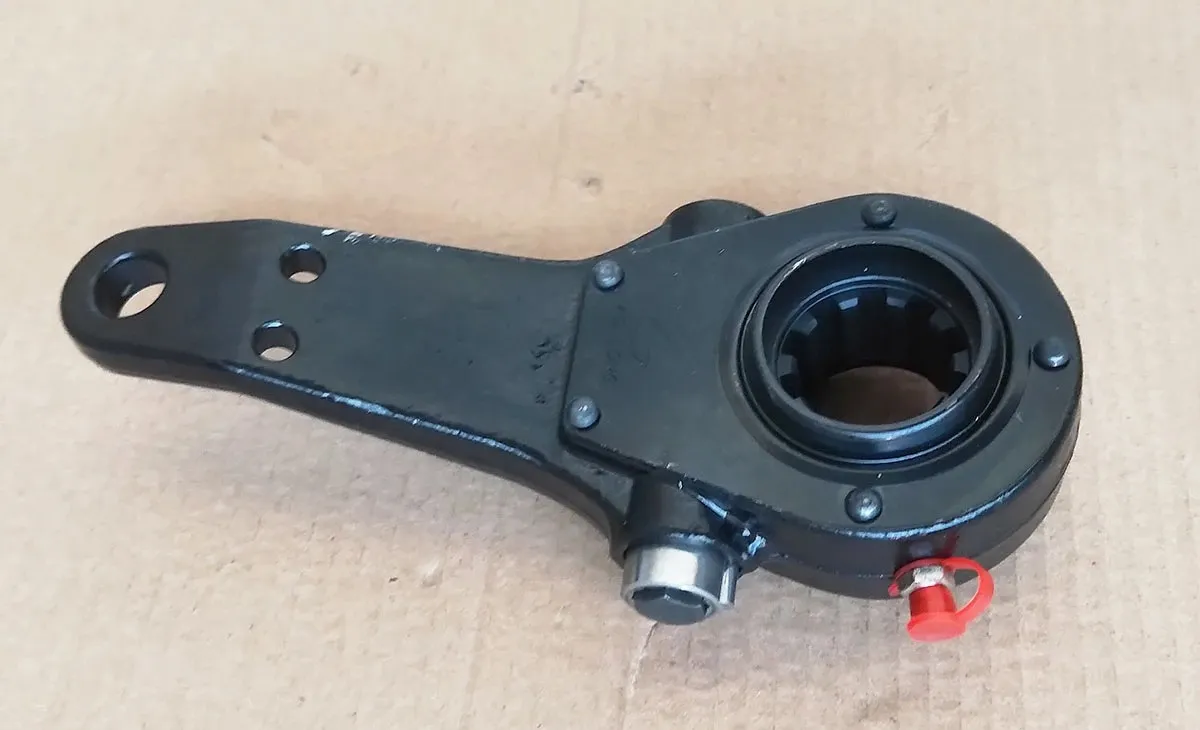
Specifications
| Type | Automatic (self-adjusting) and manual slack adjuster |
|---|---|
| Spline count | 28-spline and 10-spline camshaft fitment |
| Arm length | 5 in / 5.5 in / 6 in (127mm / 140mm / 152mm) center-to-center |
| Rotation | Clockwise and counter-clockwise, specify at order |
| Housing material | Ductile iron body, forged steel worm gear |
| Compatibility | Haldex-style automatic units, BPW/SAF/Fuwa/York manual arms |
| Boot/seal | Sealed grease chamber, rubber dust boot |
| Standard | Stroke performance to FMVSS 121 automatic adjustment requirement |
What a Slack Adjuster Does
When the driver applies the brakes, air fills the brake chamber and its pushrod extends. That pushrod is pinned to the end of the slack adjuster arm, and the arm's other end is splined onto the S-camshaft. Pushrod travel rotates the arm, and the arm rotates the camshaft, which spreads the brake shoes against the drum. The slack adjuster is, mechanically, a lever that converts the chamber's linear push into the camshaft's rotation — and like any lever, its effective length determines how much force reaches the cam for a given air pressure.
As the brake lining wears down over the life of the shoes, the shoes have to travel farther to reach the drum before they make contact, which means the chamber pushrod has to stroke farther on every application to deliver the same rotation. If that extra stroke isn't compensated, pushrod travel eventually exceeds the chamber's design stroke and the brake can no longer generate full force — this is "out of adjustment," and it is the single most common defect flagged in roadside brake inspections worldwide.
The slack adjuster's job is to keep the running clearance between shoe and drum constant regardless of lining wear, either by a mechanic manually taking up slack on a wrench-adjustable arm, or automatically through an internal ratchet mechanism that self-corrects on every brake release.
The consequence of getting this wrong is not gradual — it is a step change. A brake that is slightly out of adjustment still generates most of its rated force with a slightly delayed response. A brake that has crossed the chamber's stroke limit generates almost no force at all, because the chamber has run out of physical travel before the shoes ever reach the drum. That is why stroke length, not lining thickness, is the measurement inspectors check first at a roadside stop, and why a slack adjuster in good working order is worth more to stopping distance than most drivers assume.
Automatic vs Manual Slack Adjusters
A manual slack adjuster has a hex adjusting bolt on the housing that a technician turns with a wrench during scheduled maintenance to take up accumulated lining wear. It is mechanically simple, inexpensive, and has no internal parts to fail — but it depends entirely on the maintenance schedule being followed. A fleet that skips adjustment intervals runs brakes progressively further out of stroke without any warning until an inspection catches it or a brake fades under load.
An automatic slack adjuster (ASA), also known in the trade as self adjusting slack adjusters, contains an internal one-way clutch and ratchet mechanism that senses excess clearance on every brake stroke and takes up the slack automatically, without a technician touching a wrench. This is now the standard specification on new trailers across most markets and is mandatory equipment in the US and EU. The tradeoff is cost and the fact that an automatic unit that has already ratcheted to its mechanical limit — usually from a chamber, camshaft, or bushing problem elsewhere — needs full replacement rather than a simple manual re-adjustment.
We stock both types because a large share of the trailers running across Africa, the Middle East, and Latin America were built to older specifications with manual arms, and fleets rebuilding those axles need the correct legacy part rather than an automatic unit that won't physically match the mounting.
Cost per unit favors the manual arm, but total cost of ownership often favors automatic once labor and downside risk are counted. A fleet with a disciplined maintenance program and short routes back to a workshop can run manual arms economically for years. A fleet running long-haul routes with limited access to scheduled service, or a large number of trailers relative to available brake technicians, tends to come out ahead on automatic units simply because a missed manual adjustment on even one trailer is a real safety exposure, while an automatic unit removes that dependency on schedule discipline entirely.
Haldex-Style Automatic Slack Adjusters
"Haldex slack adjuster" has become a generic term in the trade for a particular automatic adjuster design and mounting pattern, much like the brand name itself became shorthand for the category. We manufacture automatic slack adjusters built to the same clutch-and-worm-gear architecture and external mounting dimensions as Haldex-pattern units, so they interchange directly with axles originally fitted with them, without modifying the camshaft or chamber bracket.
The internal mechanism uses a one-way clutch that engages only when pushrod stroke exceeds a set threshold — roughly the clearance created by normal lining wear between service intervals — and ratchets the worm gear a fraction of a turn to close that gap back down. Because the adjustment happens automatically on every stroke that exceeds threshold, clearance stays close to constant for the life of the lining, and stroke length stays predictable, which matters directly for stopping distance and for passing a roadside brake stroke inspection.
A worn or seized automatic slack adjuster shows up as a chamber pushrod that strokes further than spec even right after a service, or as a clicking/ratcheting noise under braking that continues even when clearance should already be correct. Neither symptom is repairable by adjustment — the internal clutch mechanism has to be replaced as a unit, which is the entire slack adjuster.
One common misdiagnosis is worth flagging: a technician who finds an automatic slack adjuster out of stroke sometimes tries to manually re-adjust it as if it were a manual arm, forcing the housing past its clutch mechanism with a wrench. This can mask the underlying fault temporarily but typically damages the internal clutch further, and the adjuster then fails again — often worse — within a short mileage. An automatic unit that is genuinely out of adjustment should be replaced, not forced back into range by hand.
Sizing: Spline Count and Arm Length
Two dimensions decide whether a slack adjuster fits: the internal spline count that mates to the camshaft, and the center-to-center arm length that sets the lever ratio. Trailer axles most commonly use a 28-spline or 10-spline camshaft depending on brand and vintage — fitting the wrong spline count will not seat onto the shaft at all, so this is the first thing to confirm, not the last. In practice this means ordering a 28 spline slack adjuster or a 10 spline automatic slack adjuster (or its 10 spline slack adjuster manual equivalent) to match the shaft, and getting that one dimension wrong is the single most common return we see on axle-end parts.
Arm length is typically 5, 5.5, or 6 inches (127mm, 140mm, or 152mm), and it is specified by the axle manufacturer to match the chamber's stroke and the brake's designed mechanical advantage — a longer arm delivers more camshaft rotation for the same pushrod stroke, but changes the geometry the chamber and cam were engineered around. Fitting a different arm length than the original changes braking force and stroke in ways that are difficult to diagnose after the fact, so we always match replacement arm length to the axle's original specification rather than to whatever happens to be in stock.
Rotation direction (clockwise or counter-clockwise, viewed from the adjuster) also has to match the side of the trailer — left and right slack adjusters are mirror-image parts, not interchangeable, so specify axle side at order alongside axle brand and camshaft spline count.
A less obvious sizing detail is the pushrod pin hole diameter and offset on the arm, which has to match the chamber clevis pin it connects to. Two slack adjusters with identical spline count and arm length can still refuse a clean fit if the pin hole is bored for a different clevis pin diameter — this is a smaller mismatch than spline count but just as capable of causing binding or excess play once installed. We manufacture to the same pin bore tolerance as the axle brands we cross-reference, rather than a single generic bore that requires reaming on installation.
Installation, Maintenance and Failure Signs
A newly installed slack adjuster should be set to minimum running clearance at installation — roughly 90 degrees of arm rotation from the released position to full chamber stroke on most designs — and an automatic unit should then self-maintain that clearance without further attention. Manual units need scheduled re-adjustment; a reasonable interval is every service or oil change, more frequently on fleets running heavy loads or frequent hard braking such as mining and quarry routes.
Grease the slack adjuster's internal bushing and camshaft bushing at every lubrication service — a dry or contaminated bushing is the most common cause of a slack adjuster binding or ratcheting incorrectly, and it is a five-minute check that prevents a much larger brake job later. Watch for a torn dust boot, which lets grit into the bushing and accelerates wear; a boot replacement kit is inexpensive compared to a full adjuster.
Warning signs that a slack adjuster needs replacement rather than adjustment: pushrod stroke exceeding the chamber's rated travel even after a fresh adjustment, visible play or wobble in the arm when the brake is released, or a clicking noise from an automatic unit under load. When replacing slack adjuster units, do it in axle-end pairs where possible, alongside a check of the brake chamber and camshaft bushing — a worn adjuster is frequently a symptom of wear elsewhere in the same brake assembly, not an isolated fault.
Keep a written or digital record of stroke measurements at each service rather than a pass/fail note only — a trend of gradually increasing stroke on one axle end, even while each individual reading still passes, is an early warning that the slack adjuster or camshaft bushing is wearing faster than its axle-mates and is worth addressing before it becomes a roadside failure. This kind of trend tracking costs nothing beyond a logbook entry and catches problems weeks before they would otherwise surface.
OEM Part Number Cross-Reference
Buyers sourcing a replacement often already have a part number stamped on the housing rather than a spline count and arm length. Everything below is a compatible replacement manufactured to the same interchange dimensions — not a genuine branded part — and we still confirm axle brand and spline count before shipping, since two housings can share a family name and differ in the details that matter.
- SC01101 — Haldex-pattern automatic slack adjuster. Our sc01101 slack adjuster matches this mounting and spline pattern.
- AS1140 — Meritor slack adjuster, also branded as a rockwell slack adjuster, automatic pattern. Our as1140 slack adjuster equivalent covers the same interchange.
- The wider Meritor-pattern automatic family — as1132 slack adjuster, as1133 slack adjuster, as1136 slack adjuster, as1138 slack adjuster, as1141 slack adjuster, as1172 slack adjuster and as1173 slack adjuster — differ from each other mainly in arm length and spline count, so we cross-reference each number individually rather than treating the family as one-size-fits-all.
- 3275 and 10268 — the two most common gunite slack adjuster part numbers for manual arms; our 3275 slack adjuster and 10268 slack adjuster equivalents are compatible replacements for the same bolt pattern and spline count.
- 40010143 — a common bendix slack adjuster part number for automatic units; our equivalent is a compatible replacement, not a genuine Bendix part.
Send us the number stamped on the housing, or the axle brand and camshaft spline count, and we confirm the correct cross-reference before shipping — a wrong-generation match is the most common return we see in this category.
Frequently Asked Questions
What is the difference between an automatic and a manual slack adjuster?
Is a Haldex slack adjuster the same as any automatic slack adjuster?
How do I know what spline count and arm length I need?
Can a slack adjuster be repaired instead of replaced?
Why does my brake chamber stroke too far even after adjustment?
How do you adjust automatic slack adjusters?
How can you check slack adjusters for wear?
Tell us the part you need and your destination port — we'll send specs & a quote today.
Reply within 24 hours — or WhatsApp us at +86 199 5331 6215.