
Slack Adjuster Guide: Types, Adjustment, and Replacement
A slack adjuster is a small part with an outsized effect on braking performance — get the type, adjustment, or angle wrong and a trailer can pass a quick air-pressure check while still stopping poorly. This guide covers slack adjuster types, how slack adjuster works, correct adjustment and angle, and the differences between Haldex and Meritor units that matter when it comes time for brake slack adjuster replacement.
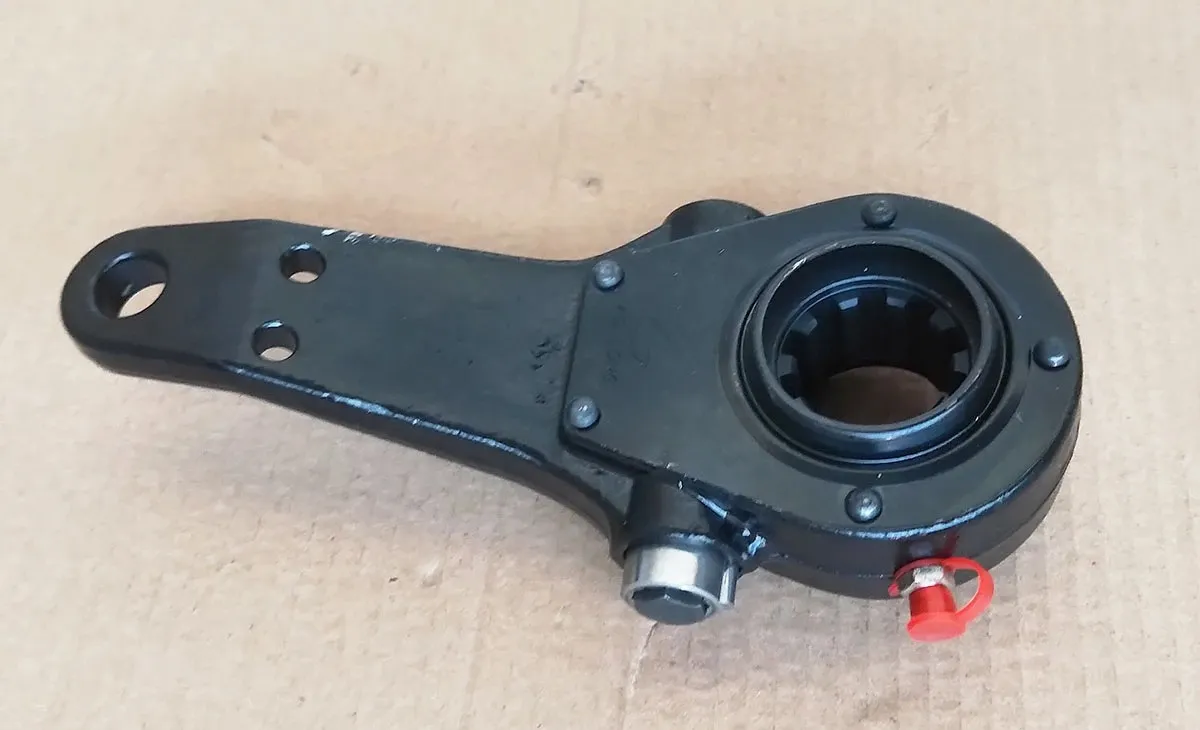
Slack Adjuster Types: Automatic vs Manual
A slack adjuster is the lever arm that sits between the brake chamber pushrod and the S-cam shaft on an S-cam drum brake, converting the pushrod's linear stroke into the rotational motion that spreads the brake shoes. Slack adjuster types split into two categories: manual and automatic. A manual slack adjuster requires a technician to periodically back off a locking screw and rotate the adjuster to compensate for lining wear, a task that gets skipped often enough in real fleet operations that manual adjusters have been phased out of new production in most markets.
An automatic slack adjuster (ASA) compensates for lining wear on its own, using an internal mechanism that resets stroke length each time the brakes are applied, as long as the lining wear stays within the mechanism's designed compensation range. Since the early 1990s in North America, and broadly since similar dates in the EU, automatic slack adjusters have been mandatory on new trailer production specifically because manual adjustment compliance was inconsistent enough to become a documented safety problem. Despite this, a meaningful share of the used-trailer market still carries older manual slack adjuster units that need to be identified and, in most jurisdictions, retrofitted. Browse our slack adjusters for automatic units matched to common chamber and axle specs.
Types of Automatic Slack Adjusters
Automatic slack adjuster types aren't limited to the manual-versus-automatic split covered above — within the automatic category itself, mounting style and arm length define a few practical subtypes worth knowing, since the terminology shows up regularly on parts catalogs and cross-reference charts. The most common mounting style on trailer S-cam brakes is the clevis-mount design, where the arm connects to the brake chamber pushrod through a clevis and clevis pin — this is the default most fleets picture when ordering a replacement ASA. A second mounting style, sometimes called hub-mount or direct-mount, bolts the adjuster body more directly against the brake spider or bracket rather than relying on a separate clevis assembly, and shows up on certain axle and brake combinations where clevis clearance is tight.
Arm length is the other variable that defines a type within either mounting style: standard-arm and long-arm (extended-arm) versions of the same base adjuster change the mechanical leverage and have to match the chamber stroke and brake geometry they're paired with, not just the spline count on the S-cam. Internally, as covered below, the two dominant designs are the clutch-and-worm mechanism typified by Haldex and the ratchet-and-pawl mechanism typified by Meritor — both self-adjusting, but not interchangeable part-for-part. When cross-shopping types of automatic slack adjusters across brands, match mounting style, arm length, and spline count together rather than assuming any ASA rated for the same chamber size will bolt straight on.
How Slack Adjuster Works
How slack adjuster works comes down to a simple mechanical relationship: air pressure pushes the brake chamber pushrod out, the pushrod pivots the slack adjuster arm, and that rotation turns the S-cam shaft, spreading the brake shoes against the drum. The length of the slack adjuster arm and the distance the pushrod travels — the stroke — together determine how much brake torque gets applied for a given air pressure.
As brake linings wear, the S-cam has to rotate further to close the same gap, which means the pushrod has to stroke further for the same braking effect. Push the stroke length past its rated maximum and the chamber cannot deliver full braking force even at full air pressure — this is the mechanism behind a trailer that has air but still brakes poorly. An automatic slack adjuster's entire job is to keep stroke length inside its rated range automatically, resetting a fraction of a turn on every brake application when incoming clearance exceeds the mechanism's built-in tolerance.
A manual unit performs the identical mechanical function but relies entirely on a technician catching the wear and backing off the adjustment screw manually — the mechanism does the same job, but nothing resets it automatically if that check is skipped.
Slack Adjuster Adjustment and Angle
Slack adjuster adjustment on a manual unit is done with the brakes fully released and cold: back off the locking mechanism, rotate the adjuster to take up slack until the brake shoe just contacts the drum, then back off a specified quarter- to half-turn to restore correct running clearance before re-engaging the lock. Over-tightening leaves no clearance and causes brake drag and overheating; under-adjusting leaves excess stroke and reduces braking force.
Slack adjuster angle matters just as much as stroke length and is the detail most commonly overlooked during installation. With the brakes fully applied, the angle between the slack adjuster arm and the pushrod should be close to 90 degrees — this is the geometry that delivers maximum mechanical advantage from the chamber's stroke. An adjuster installed at the wrong angle, or one that has drifted out of the correct angle range as lining wear progresses, loses braking leverage even though stroke length measures within spec, which is why angle should be checked visually at every brake inspection, not just stroke length with a ruler.
How to adjust slack adjuster correctly depends entirely on which type is installed, and treating an automatic unit like a manual one is a common and avoidable mistake. On a manual slack adjuster, the procedure above — back off the lock, rotate to take up slack, back off a quarter- to half-turn, re-engage the lock — is the correct, expected maintenance task, and it needs to happen on a defined schedule since nothing resets it automatically. On an automatic slack adjuster, manual adjustment is not the normal maintenance path at all: the internal mechanism is built to self-adjust with every brake application, and routinely cranking on the manual hex or adjustment bolt defeats that mechanism and can mask a failing adjuster instead of fixing it. Manufacturers are explicit on this point — how to adjust auto slack adjusters correctly, outside of the initial installation setup stroke, is generally: don't. If an ASA needs frequent manual adjustment to hold spec, that need is itself the failure symptom, and the correct response is to diagnose and replace the unit, not keep resetting it by hand. The only routine situations where a technician manually turns an automatic slack adjuster are the initial-setup learning stroke after installation (covered below) and a one-time manual reset that a manufacturer's own troubleshooting procedure specifically calls for before condemning a unit as failed.
How to Check a Slack Adjuster: The Stroke Measurement Method
How to check slack adjuster function comes down to a stroke measurement, and the method is the same whether the adjuster is manual or automatic. Start with the brakes fully released and mark the pushrod where it exits the brake chamber, using chalk or a paint marker at the point flush with the chamber housing. Have a second person make a full brake application — a full stab on the pedal, or a full application from the tractor's air supply on a parked trailer — and hold it while you measure how far the mark has traveled away from the chamber. That distance is the actual stroke.
Compare the measured stroke against the maximum allowable stroke published for that specific chamber type and size (typically in the 1-1/4 to 2-1/2 inch range depending on chamber size and whether it's a standard or long-stroke design). A stroke at or beyond the chamber's rated maximum means the brake cannot develop full force even at full air pressure, regardless of whether the adjuster is automatic or manual — and on an automatic unit specifically, a stroke that has already crept past spec despite normal driving is itself a sign the internal adjusting mechanism has failed and the unit needs replacement, not just a manual reset.
Checking slack adjusters this way is also exactly how it's evaluated during a CDL pre-trip air brake inspection: examiners expect a driver to locate the slack adjuster, explain that stroke should be checked with the brakes fully applied, and describe — or in some states physically demonstrate, engine running, with a helper applying the brakes — that the exposed pushrod travel should not exceed the chamber's maximum stroke. How to check slack adjusters CDL testing actually requires being able to walk through this stroke method out loud and also spot visible damage on the same walk-around — a bent arm, a missing cotter pin or retaining clip, obvious looseness at the S-cam — since examiners are grading both procedure knowledge and a driver's ability to recognize an adjuster in visibly bad condition.
Haldex and Meritor Slack Adjusters: What's Different
Haldex slack adjuster and Meritor slack adjuster units are the two most common automatic designs on trailers built for the North American and European markets, and while they perform the same job, they are not always physically or procedurally interchangeable. A Haldex slack adjuster typically uses an internal clutch-and-worm mechanism with its own specific initial-setup procedure — a learning stroke sequence that must be performed correctly when first installed or the automatic adjustment will not track wear correctly from day one. As a Haldex self adjusting slack adjuster, it relies entirely on that internal mechanism once it's calibrated correctly, not on any driver or technician intervention.
A Meritor slack adjuster uses a different internal ratchet-and-pawl mechanism with its own set of initial calibration steps, and Meritor publishes a distinct troubleshooting sequence for diagnosing an adjuster that has stopped tracking wear correctly. Mounting spline count, arm length, and initial stroke settings differ enough between the two brands — and even between different models within each brand's own lineup — that swapping one brand's adjuster onto a chamber originally speced for the other brand needs a spec check first, not just a bolt-pattern match.
Whichever brand a fleet standardizes on, keeping the initial-setup procedure documented and followed consistently at installation matters more than which of the two brands is chosen; both perform reliably when installed and calibrated per the manufacturer's specific procedure. Bendix is the other major name in this space, and Bendix slack adjuster adjustment follows the same don't-touch-it-manually principle as Haldex slack adjuster adjustment and Meritor slack adjuster adjustment — each brand's automatic mechanism is built to self-compensate, and the only routine technician involvement is the initial-setup stroke and the periodic stroke-and-angle inspection covered above.
Brake Slack Adjuster Replacement: When and How
How to change a slack adjuster is really a question of when, not how — the mechanical swap itself is straightforward once the failure is confirmed. Brake slack adjuster replacement is warranted when the automatic mechanism no longer tracks lining wear correctly — diagnosed as a stroke length that keeps creeping back out shortly after a manual reset, which indicates the internal ratchet or clutch mechanism itself has failed rather than just needing adjustment. A cracked or bent adjuster arm, a stripped spline where the adjuster mounts to the S-cam shaft, or visible play in the adjuster body are all straightforward replacement triggers rather than adjustment issues.
Replacement means matching arm length, spline count, and rotation direction (clockwise or counterclockwise, since brakes on opposite sides of an axle usually use mirrored adjusters) to the original unit exactly — an adjuster with the wrong arm length changes the mechanical leverage ratio even if it physically bolts onto the same spline. After installing a replacement automatic slack adjuster, the initial-setup or learning stroke procedure specific to that brand has to be performed before the unit is trusted to track wear correctly going forward; skipping this step is a common reason a freshly replaced adjuster appears to malfunction within days. See our full trailer brake system range for matched chambers, cams, and adjusters.
Installing and Setting Up a New Slack Adjuster
How to install automatic slack adjusters starts before the wrench ever touches the mounting bolt: confirm arm length, spline count, and rotation direction against the original unit, and check that the chamber and adjuster are rated for the same stroke range. How to install a Haldex automatic slack adjuster specifically means following Haldex's own initial-setup learning stroke — a short sequence of full brake applications right after mounting that lets the internal clutch-and-worm mechanism learn its starting clearance; skipping this step is why some fresh Haldex installs seem to malfunction within the first few days of service.
How to set automatic slack adjusters correctly comes down to that same learning-stroke sequence rather than any manual dial-in — an ASA sets its own baseline once the brand-specific installation procedure has been followed and a few brake applications have cycled the mechanism. How to back off automatic slack adjusters is, in day-to-day terms, not something a technician should be doing at all: the self-adjusting mechanism backs itself off a fraction of a turn on every application, and forcing it back off with a wrench outside the initial setup or a manufacturer-specified reset procedure can mask a mechanism that's already failing rather than fix anything.
Slack Adjuster Terminology in French-Speaking Markets
French-speaking fleets and parts buyers use their own terms for this assembly, and matching them on a quotation avoids confusion. An automatic slack adjuster is a régleur automatique de frein; more generally, the adjustment mechanism itself — automatic or manual — is called a régleur de jeu, literally a clearance adjuster. The arm that connects the pushrod to the S-cam is the levier de frein, the brake lever, in French-language parts catalogs and service manuals. Buyers submitting French-language tenders for brake components should expect suppliers to recognize all three terms interchangeably, since regional catalogs from France, Quebec, and North and West Africa vary in which term they default to.
Frequently Asked Questions
What is the difference between an automatic and manual slack adjuster?
How do I know if my slack adjuster needs adjusting or replacing?
What angle should a slack adjuster be at?
Are Haldex and Meritor slack adjusters interchangeable?
How often should slack adjusters be inspected?
What happens if a slack adjuster is adjusted too tight?
How do you adjust a slack adjuster?
How do you adjust auto slack adjusters without damaging the mechanism?
How do you check a slack adjuster?
How do you check slack adjusters for a CDL pre-trip inspection?
How do you install, adjust, measure, and test a slack adjuster?
How can you check slack adjusters for a CDL road test?
How do you adjust air brake slack adjusters?
Tell us the part you need and your destination port — we'll send specs & a quote today.
Reply within 24 hours — or WhatsApp us at +86 199 5331 6215.