
Trailer Tire Guide: Size, Pressure, and Wear Patterns Explained
Tire decisions on a semi-trailer come down to three numbers most buyers glance past: trailer tire size, load rating, and speed rating. Get any of the three wrong and the tire that looked fine on paper fails early, unevenly, or dangerously under load. This guide covers trailer tire size and the 11R22.5 vs 12R22.5 decision, how to choose trailer tires for a given route, correct tire pressure, and the wear patterns and maintenance habits that catch a failing tire before it becomes a roadside breakdown.
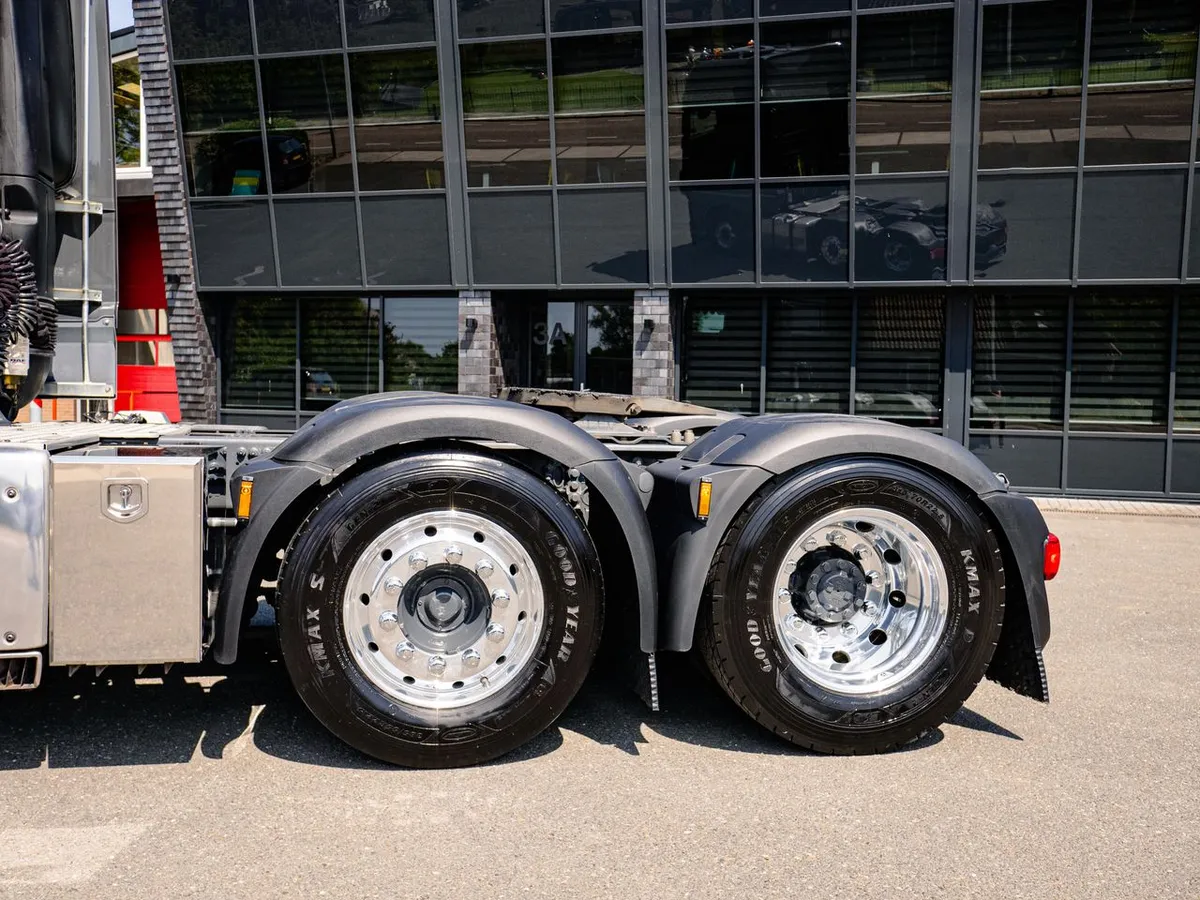
Trailer Tire Size: Reading the Sidewall
Trailer tire size is stamped directly on the sidewall in a format like 11R22.5 or 295/75R22.5, and knowing how to read trailer tire size correctly avoids the single most common tire-buying mistake: ordering a tire that physically fits the rim but cannot carry the trailer's rated axle load. The number before R is either the tire's nominal width in inches (11R22.5) or width in millimeters plus aspect ratio (295/75R22.5); the number after R is the rim diameter in inches. R itself means radial construction, distinct from the older bias-ply designation.
Beyond size, two codes on the same sidewall matter just as much: the tire load rating (a load index number or ply rating like 14PR, tied to a maximum load table) and the tire speed rating (a letter code — commonly J, L, or M on trailer tires — capping the tire's rated speed). Mismatching either one to the trailer's actual operating conditions is a common cause of tire failure that gets blamed on bad tires when the real issue was ordering the wrong load or speed rating for the application.
A wheel tire size chart, or tire size wheel width chart, cross-references a tire's section width against the range of rim widths it can be safely mounted on, and every trailer tire size has more than one compatible rim width, not just one exact match. As a rough guide across common commercial trailer sizes: an 11R22.5 tire mounts on rims from about 7.50 to 8.25 inches wide, with 8.25 inches the standard fit on most trailer wheels; a 12R22.5 or 295/75R22.5 tire needs a wider 8.25 to 9.00 inch rim, with 9.00 inches the typical spec, to seat the bead correctly and support the tire's wider footprint. Mounting a tire outside its charted rim-width range distorts the contact patch and sidewall profile even when the bead technically seats, which shows up later as uneven wear or a tire that runs hotter than it should. Always check the tire manufacturer's tire size wheel width chart against the actual rim on hand rather than assuming any 22.5 inch rim fits any 22.5 inch tire. The same lookup goes by several names depending on the supplier: wheel tire width chart, tire and wheel width chart, tire and wheel fitment chart, wheel tire fitment chart, wheel tire size converter, wheel width to tire width chart, wheel and tyre sizes explained, or wheel tyre sizes explained.
Always cross-check trailer tire size against the axle and rim rating together, not just against the tire that was previously mounted — previous owners occasionally fit an undersized tire that happened to bolt on, and matching it perpetuates an existing mismatch rather than correcting it. Browse our trailer tires for correctly rated sizes across common axle configurations.
11R22.5 vs 12R22.5: Which Size Fits Your Trailer
The 11R22.5 vs 12R22.5 decision comes up constantly on trailer axle specs because both sizes mount on the same 22.5 inch rim, and the difference is easy to overlook until load capacity or clearance becomes a problem. An 11R22.5 tire is the more common trailer size, generally rated for lighter to mid-range axle loads at a given ply rating. A 12R22.5 tire is wider and taller, rated for meaningfully higher loads at the same ply rating, but it needs a wider rim and more fender or frame clearance — not a drop-in swap onto a trailer built around 11R22.5 dimensions.
Fleets sometimes try to upgrade to 12R22.5 for extra load margin without checking clearance first, and the tire rubs against the fender or frame on full suspension travel. The correct sequence is: confirm the rim width rating matches, confirm physical clearance at full compression, and only then compare load tables between the two sizes to see whether the upgrade is actually needed for the trailer's rated GVW.
For most general freight trailers, 11R22.5 remains the practical default; 12R22.5 earns its keep specifically on trailers running consistently near their maximum rated axle load, where the extra load margin has a real payoff.
How to Choose Trailer Tires for Your Application
How to choose trailer tires starts with duty cycle, not price. A trailer running long highway hauls at steady speed benefits from a radial tire — the belt construction runs cooler, wears more evenly, and delivers better fuel economy than an older bias tire design. A trailer working short, rough routes — scrap yards, construction sites, unpaved lots — sometimes still runs bias tires deliberately, because bias construction resists sidewall cuts and punctures better than a radial's thinner sidewall, even though it rides harsher and wears less evenly over long distances.
The radial vs bias tire decision also affects retreading: radial casings retread more times over their service life than bias casings, when the casing has been properly maintained, which changes the total cost of ownership calculation for high-mileage fleets. Trailer position matters too — steer-position rules do not apply to trailer axles, but axle position within a tandem or tri-axle group still affects wear rate, since the lead axle in a group typically wears faster under braking loads.
Budget, expected annual mileage, and route surface should all factor into the size, ply rating, and radial-vs-bias decision before price becomes the deciding factor — a cheaper tire that wears out or fails early costs more in downtime than the price difference ever saved.
Trailer tire cost varies enormously depending on which product the buyer actually means. A small ST-rated tire for a utility or cargo trailer costs a fraction of a commercial unit, while tractor trailer tire cost for an 11R22.5 or 12R22.5 tire mounted on a semi-trailer runs several times higher per tire, reflecting the load rating, casing thickness, and mileage life difference between the two product categories.
Trailer Tire Pressure and Load Rating
Trailer tire pressure is the single most-skipped check in routine trailer maintenance, and it is also the number with the most direct effect on tire life: running even 10-15% underinflated generates enough extra heat to measurably shorten tread life and raises blowout risk, while overinflating reduces the tire's contact patch and accelerates center-tread wear. Correct pressure is set against the tire's actual load rating for the axle weight being carried, not a single number applied to every trailer — a partially loaded trailer and a trailer at max GVW may call for meaningfully different pressures within the tire manufacturer's load-and-inflation tables.
Because tire load rating is tied directly to inflation pressure — a tire only achieves its full rated load capacity at its rated pressure — an underinflated tire is not just running softer, it is functionally overloaded even if the trailer's actual cargo weight is within the axle's rating. This is the mechanism behind heat-related sidewall failures on tires that looked fine before a blowout.
A simple, low-cost habit fixes most of this: check pressure cold, before the trailer moves, on a fixed schedule rather than only when a tire looks visibly low — a tire can lose meaningful pressure without appearing obviously flat.
Tire Wear Patterns and What They Tell You
Tire wear patterns are a diagnostic tool, not just a sign it is time to replace. Even wear across the tread face means alignment and inflation are both correct. Wear concentrated at the shoulders points to underinflation; wear concentrated at the center points to overinflation. Cupping — a scalloped, wavy wear pattern around the tread — usually points to a suspension or bushing problem, not the tire itself, and replacing the tire without fixing the underlying suspension issue just repeats the same wear pattern on the new tire.
Diagonal or feathered wear across the tread blocks generally indicates a toe or alignment issue on the axle, worth checking before assuming the tire itself is defective. Uneven wear between tires on the same axle, left versus right, often points to a bent axle or a brake dragging on one side rather than a tire problem at all.
Trailer tire rotation extends even wear across a tandem or tri-axle set by moving tires between positions that naturally wear at different rates — lead axles in a group typically see more braking load than trailing axles. A rotation schedule tied to a fixed mileage interval, rather than only rotating when wear is already visible, catches uneven wear before it becomes irregular enough to require early replacement.
Retread Tires and Tire Maintenance
Retread tires reuse a worn tire's casing with a new tread bonded on, and for trailer axles — which do not steer and therefore see more even load distribution than drive or steer positions — a good-quality retread on a sound casing performs close to a comparable new tire at a meaningfully lower cost. The deciding factor is casing condition: a casing with sidewall damage, prior repairs in the wrong location, or heat history from a prior underinflation event should not be retreaded regardless of how good the tread looks, since the casing itself is what fails on a retread, not the tread.
A basic tire maintenance routine covers four things at every PM interval: pressure check against the load table, tread depth measurement across the tread face (not just the center), visual inspection for sidewall cuts or bulges, and a wear-pattern check to catch alignment or suspension issues early. None of these require special tools, and together they catch the large majority of tire-related roadside failures before they happen.
Fleets that track tire maintenance data by trailer number, rather than treating tires as disposable and unmonitored, consistently get more total miles per tire and catch casing damage early enough to keep tires eligible for retreading rather than scrapping a casing that still had life in it.
Trailer Tire Terminology in Other Markets
Export documentation for trailer tires uses regional terms that do not always translate literally. French-language buyers order a pneu semi remorque or, more generally, a pneu remorque; when specifying dimensions, the relevant phrase is taille pneu remorque, and inflation is checked against the pression pneu remorque table supplied with the trailer.
Spanish-language markets use neumático semirremolque for the specific semi-trailer application and neumático remolque more broadly; presión neumáticos remolque covers the inflation table, and tamaño neumático refers to the size designation stamped on the sidewall.
Portuguese-speaking markets — Brazil in particular — use several regional variants for the same part: pneu semirreboque, pneu carreta, pneu para carreta, pneu de carreta, and pneu reboque all appear on different suppliers' catalogs and buyer requests for what this guide calls a trailer tire, with carreta being the more colloquial term for a semi-trailer in Brazilian Portuguese and reboque the more formal or European Portuguese term.
Arabic-language tenders specify إطار نصف مقطورة for the semi-trailer tire itself, and ضغط إطارات المقطورة when the tender is specifically about tire pressure requirements and inflation tables.
Frequently Asked Questions
What is the difference between 11R22.5 and 12R22.5 tires?
How much air pressure should trailer tires have?
Can I mix radial and bias tires on the same trailer?
How do I know if a tire wear pattern means an alignment problem?
Are retread tires safe for trailer axles?
How often should trailer tires be rotated?
What does the speed rating letter on a trailer tire mean?
How much does a trailer tire cost?
What is the typical tractor trailer tire cost for a semi-trailer?
When should I replace my trailer tires?
Tell us the part you need and your destination port — we'll send specs & a quote today.
Reply within 24 hours — or WhatsApp us at +86 199 5331 6215.