
Trailer Leaf Spring Guide: Types, Specification, and Failure Signs
A trailer's ride quality, load capacity, and axle alignment all trace back to one component: the leaf spring pack. This guide breaks down leaf spring types, walks through how leaf springs work, and covers the specification numbers and failure signs that separate normal wear from a leaf about to snap on the highway.
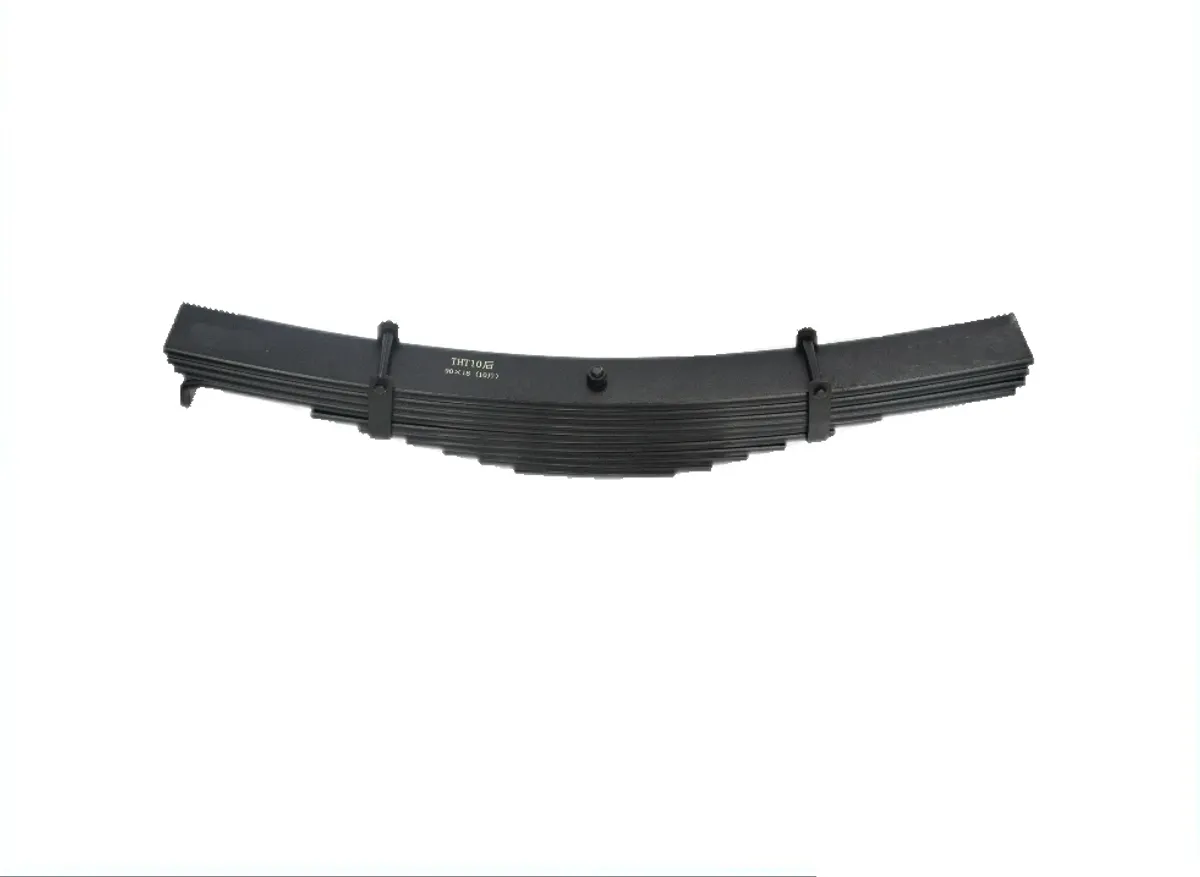
Leaf Spring Types: Parabolic vs Multi Leaf Spring
Trailer leaf spring types — or, phrased the other way around, the types of trailer leaf springs a buyer will actually encounter — split into two practical categories: multi leaf and parabolic. A multi-leaf spring stacks several leaves of near-constant thickness, graduated in length, clamped together at the center bolt. It is inexpensive, easy to source, and forgiving of overload — the extra leaves act as a built-in safety margin — which is why it remains the default on flatbeds, tippers, and general cargo trailers. A parabolic leaf spring uses fewer leaves, usually two to four, each tapered from thick at the center to thin at the tips, giving a smoother ride and shedding meaningful unsprung weight versus a multi-leaf pack of equivalent capacity.
The parabolic vs multi leaf spring choice comes down to duty cycle. Multi-leaf packs tolerate overload and rough handling better because inter-leaf friction spreads stress across the stack; parabolic springs ride softer and last longer under correctly-rated loads but are less forgiving of the occasional overload common on informal cargo routes. Fleets running scrap, aggregate, or construction routes generally stay with multi-leaf for that reason alone.
Leaf spring material is almost always a silicon-manganese spring steel, heat-treated and shot-peened to relieve surface stress concentrations that would otherwise seed fatigue cracks. Cheaper replacement springs sometimes skip the shot-peening step to save cost; the leaves look identical but fail in a fraction of the rated cycle life. Reputable suppliers list the steel grade and heat-treatment spec on the product sheet — if that information is missing, treat it as a red flag on load rating and fatigue life alike. Browse our trailer leaf springs for both configurations built to documented steel and heat-treatment specs.
How Leaf Springs Work
A leaf spring does two jobs at once: it absorbs vertical shock from the road surface, and — on most trailer axle configurations — it also transmits driving and braking torque from the axle to the frame, since there is no separate torque arm. Understanding how leaf springs work starts with the center bolt, which locates the spring pack on the axle seat, and the leaves themselves, which flex and slide against each other as the axle moves up and down.
At the front, the spring pack usually bolts rigidly to a fixed hanger. At the rear, it connects to a shackle — a pivoting link that lets the spring's effective length change as it flexes, since a leaf spring's arc flattens under load and would otherwise stretch the mounting points apart. Interleaf friction from the leaves sliding against each other actually provides a secondary damping effect, on top of whatever shock absorbers the trailer uses, which is part of why a completely dry, ungreased spring pack rides harsher even before any leaf actually cracks.
On tandem and tri-axle trailers, the spring pack usually connects through an equalizer beam that shares load between axles as the trailer crosses uneven ground, keeping all axles roughly equally loaded rather than letting one axle carry a pothole impact alone.
Leaf Spring Specification: Spring Rate, Length, and Camber
A proper leaf spring specification sheet — sometimes requested as a leaf spring dimensions chart or simply a leaf spring size chart — lists five numbers a buyer actually needs: rated capacity, spring rate, free length, camber, and eye-to-eye center distance. Spring rate — the load in kilograms or pounds needed to deflect the spring one unit of travel — is the number that determines ride quality and how the spring shares load with any air suspension components it might be paired with on a mixed setup. A higher spring rate rides stiffer and resists bottoming out under overload but transmits more shock into the cargo and chassis.
Camber, the upward arc built into an unloaded spring, matters more than most buyers realize: too little camber and the spring sits nearly flat before any load is applied, leaving almost no reserve travel before the axle housing hits the frame on a pothole; too much and the trailer rides nose-high empty. Eye-to-eye center distance and free length must match the trailer's existing hanger spacing exactly — a spring that is even 10 mm off in eye spacing will pre-load the shackle incorrectly and wear it out early.
When ordering replacement springs, matching rated capacity to axle rating — not to the number stamped on the old, possibly already-sagged spring — is the detail most commonly missed. A sagged spring can visually look correct while its actual spring rate has already dropped 15-20% from new. Pair new springs with matched trailer axles when capacity is in question.
How to Measure Trailer Leaf Springs
Whether the search is how to measure leaf springs on a trailer, how to measure a trailer leaf spring, how to measure a leaf spring on a trailer, how do you measure a leaf spring, how to measure for leaf springs, or how to measure leaf springs for trailer, the procedure below is the same five-number process. Knowing how to measure trailer leaf springs correctly matters whether you're ordering a replacement against a catalog number or reverse-engineering a spec for a trailer with no paperwork at all. Do the whole procedure with the spring pack unloaded — off the trailer, or with the axle fully supported so no weight rests on the spring — since arc height and even free length shift once a load is applied and will give a false reading if measured under the trailer's own weight.
Start with eye-to-eye length: measure from the center of one spring eye to the center of the other. Most catalogs specify this as a straight-line distance rather than a measurement following the curve of the leaf, since straight-line eye-to-eye is what actually sets hanger spacing on the frame. Next, count the leaves in the pack and measure the thickness and width of each leaf with calipers — leaf count together with thickness and width is what determines load capacity and spring rate, not the overall visual size of the stack. Measure the eye diameter as well, meaning the inner bore where the bushing seats, since eye bushings come in several bore sizes and a mismatch here is one of the most common reordering mistakes we see.
Locate the center bolt and measure its offset from the true midpoint of the eye-to-eye length. On many trailer applications the center bolt is deliberately offset a set distance to position the axle correctly relative to the frame, and getting this number wrong shifts axle position front-to-back once the new spring goes in. Finally, measure arch height, also called camber: with the pack unloaded and resting flat, lay a straight edge across both eyes and measure the vertical gap down to the underside of the center of the pack. That single number tells you how much a spring has already sagged compared to a new part carrying the same catalog capacity.
So how do you measure leaf springs when there's no part number or paperwork to start from at all? Work through the same five numbers in order — eye-to-eye length, leaf count and dimensions, eye diameter, center bolt offset, and arch height — and match them against a manufacturer's spec sheet rather than guessing from the trailer's GVW alone, since two trailers in the same weight class can use different eye spacing depending on frame design. The general approach for how to measure leaf springs is identical whether the pack is off a tandem-axle flatbed or a single-axle utility trailer: unloaded, five numbers, matched against a spec sheet rather than memory of a similar-looking part.
Trailer Spring Hanger and Mounting Points
The trailer spring hanger is the bracket welded or bolted to the frame rail that anchors each end of the leaf spring pack. Front hangers are typically rigid, fixed-pivot brackets; rear hangers carry the shackle that allows for the spring's length change under flex. Some catalogs list this same hardware as leaf spring shackles explained in a single diagram, since the shackle's pivoting geometry is easier to show than describe. Because the hanger absorbs every road shock the spring itself transmits, hanger cracking at the weld is one of the most common trailer frame failures, and it is frequently misdiagnosed as a spring problem when the spring itself is fine.
Inspecting the hanger means checking for elongated bolt holes (a sign the bushing has already failed and the pin is hammering the hanger plate directly), cracked welds at the frame rail, and bushing wear that lets the hanger rock rather than pivot cleanly. A worn hanger bushing shows up on the road as a clunk on acceleration or braking, distinct from the tire noise or shock-related clunk that leaf spring failure itself produces.
Replacing a spring without also inspecting its hangers is a common shortcut that leads to a repeat failure within months — the new spring is fine, but a worn hanger bushing lets it move in ways the design never intended, accelerating wear on the new part.
Leaf spring bushing replacement cost is driven almost entirely by labor rather than parts — a bronze or polyurethane hanger bushing itself is a low-cost item, but pressing out a seized, corroded bushing and pressing in the replacement is what actually consumes shop time, especially on a hanger that hasn't been serviced in years. Parts cost stays minor on this job; most of the invoice comes from labor hours, penetrating fluid, and occasionally a sheared shackle pin or bolt discovered during removal. Doing both hangers on an axle at the same time, rather than one at a time as each fails, is usually the more economical way to handle it once a shop is already set up for the job.
Leaf Spring Failure, Maintenance, and Replacement
Leaf spring failure rarely happens without warning. The most common early sign is a single leaf crack, usually starting at the center bolt hole or at the tip of a leaf where stress concentrates — visible as a hairline crack that widens over a few thousand kilometers before the leaf actually separates. A full leaf spring maintenance routine checks for this at every PM interval, along with sag (measured as ride height compared to a known-good reference), broken center bolts, and shackle pin wear.
Sag is the quieter failure mode: a spring pack that has lost 10-15% of its arc height still holds the axle in place and does not look obviously broken, but it has already lost a proportional share of its spring rate and load capacity. Left long enough, a sagging spring accelerates wear on tires, coupling geometry, and the axle's own bushings by changing the trailer's ride height and alignment.
Leaf spring replacement is generally done as a full pack, not leaf by leaf — mixing a new leaf into a worn pack creates uneven stress distribution that cracks the new leaf faster than if the whole pack had simply been left alone. Budget for hangers, shackles, and bushings at the same time; replacing only the spring while reusing worn hardware is a common reason a new spring fails again within a year.
Trailer leaf spring replacement cost scales mainly on two variables: whether you're replacing a single leaf (not recommended, as covered above) versus a full pack, and whether you specify OEM-brand springs and hardware or a quality aftermarket equivalent. A full-pack replacement runs higher upfront in parts than swapping one leaf, but it avoids the uneven-stress problem that shortens the life of a mixed-age pack. Aftermarket springs built to the same steel grade and heat-treatment spec as OEM come in well below OEM pricing without a meaningful difference in fatigue life; the bigger swing on any given replacement job tends to be labor — how seized the shackle pins and center bolt are, and how much rust has to be cut or pressed through — rather than the springs themselves. A firm total generally needs an in-person or photo-based quote, since a corroded hanger or a sheared shackle bolt discovered mid-job can add meaningfully to the original estimate.
Leaf Spring Terminology in Other Markets
Export orders for trailer leaf springs come in under a range of local names. French-language buyers order a lame de ressort remorque (trailer leaf spring) or simply a ressort à lame (leaf spring); when the parabolic design specifically is wanted, the correct term is ressort parabolique.
Spanish-language spec sheets call the part a muelle de ballesta, and when specifying the trailer application, ballesta remolque. Portuguese-speaking buyers — largely in Brazil, Angola, and Mozambique — order mola de lâmina for an individual leaf or feixe de molas reboque for the full trailer spring pack.
Arabic-language tenders list the part as نابض ورقي, leaf spring directly translated, though some regional suppliers and older catalogs still use the Turkish-derived ياي ورقي, particularly in markets with historical Ottoman trade ties. Matching the correct regional term on a quotation avoids the back-and-forth that comes from a buyer not recognizing an unfamiliar translation.
Frequently Asked Questions
What is the difference between a parabolic and multi leaf spring?
How do I know my leaf springs need replacing?
What is spring rate and why does it matter?
Can I replace just one leaf in a spring pack?
How often should trailer leaf springs be inspected?
What causes premature leaf spring failure?
How do I measure trailer leaf springs before ordering a replacement?
How do you measure leaf springs if you don't have the original part number?
How much does trailer leaf spring replacement cost?
What does leaf spring bushing replacement cost typically depend on?
Tell us the part you need and your destination port — we'll send specs & a quote today.
Reply within 24 hours — or WhatsApp us at +86 199 5331 6215.