
Trailer Leaf Springs
As a leaf spring manufacturer and leaf spring supplier, we forge and heat-treat leaf spring assemblies for semi trailers, tippers, flatbeds, and lowbeds in both parabolic and multi-leaf configurations — every leaf spring on a trailer we ship is cut, formed, and camber-set in house, which matters for any trailer with leaf springs running mixed axle loads across a fleet. Every leaf spring is cut from 60Si2Mn or 55CrMnA spring steel, shot-peened for fatigue resistance, and set to a specified camber before assembly. Leaf counts range from 3-leaf parabolic packs to 9-leaf multi-leaf stacks rated for overload and off-road duty. Because spring width, eye diameter and camber all have to match the axle underneath, most fleets order trailer leaf springs and axles together rather than mixing suppliers.
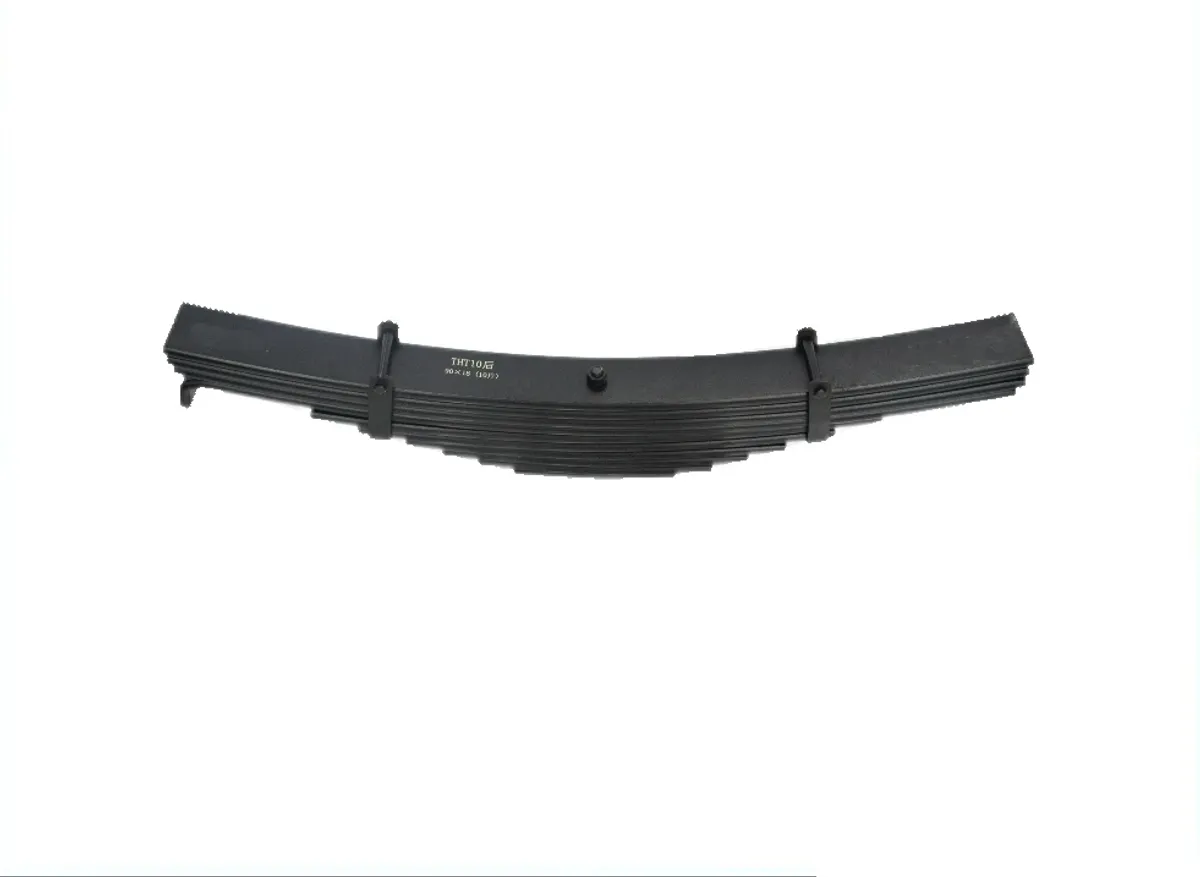
Specifications
| Steel Grade | 60Si2Mn, 55CrMnA |
|---|---|
| Configuration | Parabolic (2-4 leaf) or Multi-leaf (5-9 leaf) |
| Capacity per Spring | 3,000 kg - 8,000 kg |
| Eye Type | Rolled eye or slipper (sliding) end |
| Center Bolt | M12, M14, M16 (grade 8.8) |
| Camber | Set to drawing, typically 90-180 mm free camber |
| Heat Treatment | Quench and temper, HRC 42-48 |
| Surface Finish | Shot-peened + black e-coat or hot-dip galvanized |
| Width Options | 76 mm, 90 mm, 100 mm |
| Standard Length | 1050 mm - 1500 mm (custom lengths on request) |
Parabolic vs Multi-Leaf: Choosing the Right Leaf Spring
A parabolic leaf spring uses two to four tapered leaves — covering both a 4 leaf spring trailer and 4 leaf springs for trailer order, sometimes listed simply as trailer leaf springs 4 leaf — each thickest at the center bolt and thinning toward the eyes, so the pack shares stress evenly. That taper cuts inter-leaf friction almost to zero, which gives a noticeably softer, quieter ride and shaves several kilograms off unsprung weight compared to a multi-leaf pack rated for the same load. It's the configuration we recommend for highway reefers, tankers, and any fleet where ride quality and fuel economy matter more than field-repair simplicity.
A multi-leaf spring assembly — the lightest is a 5 leaf spring trailer pack — stacks five to nine leaves of constant cross-section, from the longest master leaf down to progressively shorter leaves clamped underneath, and either configuration ships as a heavy duty leaf spring or heavy duty trailer leaf springs build for overload duty. The leaves rub against each other under load, which adds interleaf friction and a stiffer, more damped response — exactly what's wanted on broken haul roads, mine sites, and overload duty where a bent or cracked leaf needs to be swapped out with basic tools rather than a full assembly change. Most of what we ship into African and Middle Eastern markets is multi-leaf for this reason: any welder with a bench vise can pull a leaf and replace it.
Both types pair with the same trailer suspension hangers and leaf spring equalizer beams once eye spacing and center bolt position match the original spec, so a fleet running mixed trailers doesn't need to standardize on one type across the yard.
Steel Grade, Leaf Count, and Capacity Rating
We cut leaves from 60Si2Mn or 55CrMnA silicon-manganese spring steel, both of which hold up under repeated flex without losing set. After forming, each leaf goes through quench-and-temper heat treatment to bring hardness into the HRC 42-48 range, then shot peening to induce compressive surface stress that delays fatigue crack initiation — the single biggest factor in how many loaded miles a leaf spring assembly survives before a leaf snaps.
Leaf count and capacity scale together: a 3-leaf parabolic pack in 90 mm width typically carries 3,000-4,000 kg per spring, a 5-leaf multi-leaf pack in the same width runs 4,500-6,000 kg, and a 7 to 9-leaf stack pushes past 6,500-8,000 kg for tri-axle tippers and heavy lowbeds. Single axle trailer leaf springs typically use the lighter 3- to 5-leaf end of that range, including 3500 lb trailer leaf springs sized for North American single-axle utility trailers, since one axle carries the full trailer weight on its own rather than sharing it across a tandem or tridem group. We size leaf count and thickness against the actual axle rating rather than defaulting to a stock catalog number, since an under-rated semi trailer leaf spring sags permanently within months on overloaded routes while an over-rated one rides harsh and wears bushings faster than it should.
Corrosion protection is matched to the trade lane: black e-coat is standard for dry inland routes, hot-dip galvanizing goes on anything destined for coastal, monsoon, or de-icing-salt regions where an unprotected leaf spring can lose 20-30% of cross-section to rust within a few seasons.
Eye Types, Center Bolt Sizing, and Shackle Compatibility
Each leaf spring assembly needs a fixed rolled eye on one end and, depending on the suspension geometry, either a second rolled eye — a double eye leaf spring, also ordered as double eye leaf springs or double eye trailer leaf springs — or a slipper (sliding) end on the other. The fixed eye bolts straight to the front hanger bracket; the rear end either pivots on a rear leaf spring shackle through a rolled eye or slides directly against a slipper pad cast into the rear hanger, which lets the spring's effective length change slightly as it flexes without inducing binding stress. Getting eye diameter, eye spacing, and slipper pad width wrong is the most common reason a replacement leaf spring for trailer use won't seat in existing hangers, so we confirm all three dimensions against the original part before quoting a trailer leaf springs replacement. Trailer spring shackles are what let that rolled eye move slightly at the hanger rather than binding as the spring flexes, and we size them from the same eye diameter and pin size as the spring they're paired with.
Center bolts — the bolts for leaf springs, sometimes ordered simply as trailer leaf spring bolts, that clamp the pack into one unit — run M12 to M16 in grade 8.8, sized so the stack acts as a single body under load rather than leaves shearing sideways against each other. Bolt head orientation matters too — it has to clear the axle seat and U-bolt plate, which is why we ask for the mounting orientation on custom orders. The leaf spring u bolt plate and center clamp that secure the finished assembly to the trailer axle are sized to the same spring width and axle seat diameter, so we quote them together to avoid a mismatched clamp width showing up after the parts have already shipped. A u bolt for leaf spring and a shackle for leaf spring replacement both have to match the same spring width and eye diameter as the spring itself — ordering them separately from different sources is the most common cause of a clamp that doesn't seat evenly or a shackle pin that binds. We can also supply the matching trailer leaf spring bracket and trailer leaf spring hanger — or a full trailer leaf spring hanger kit with U-bolts and shackles included — alongside the spring itself so everything arrives sized to the same eye spacing; see our trailer suspension range if you only need hanger brackets ordered separately.
Camber, Fatigue Life, and Field Inspection
Free camber — the upward curve built into an unloaded leaf spring — is set during heat treatment to a target dimension, typically 90-180 mm depending on spring length and rated capacity. Camber determines ride height at both empty and loaded conditions; a spring that's lost more than about 15-20 mm of camber compared to spec is fatigued and riding on reduced travel even if no leaf has visibly cracked yet. A properly cambered trailer leaf spring suspension keeps ride height consistent from the first loaded mile to the five-hundred-thousandth. We check camber on every batch against the drawing before packing, since a spring that ships flat or over-cambered will throw the trailer's ride height off on installation.
Expected service life for a properly rated leaf spring assembly running within its load rating is 300,000-500,000 km on paved routes, less on constant off-road or overload duty where cyclic stress accumulates faster. A broken leaf spring on trailer axles usually shows up first as a cracked or snapped leaf near the center bolt, visible gaps opening between leaves under load, or a trailer that visibly sags to one side — any of which means the assembly needs replacing rather than just re-shimming — most trailer leaf spring repair jobs start with exactly this camber check. We recommend visual inspection at every service interval and immediate replacement of any leaf spring showing a crack, since a single failed leaf overloads the remaining leaves and accelerates their failure too. A worn leaf spring and shackle combination is usually replaced together for exactly this reason, even when only one of the two shows visible wear.
Leaf Spring Bushings and Shackle Kits
Every rolled eye is pressed with a leaf spring rubber bushing so the shackle pin rotates against replaceable rubber, not the eye bore itself. We supply trailer leaf spring bushings in natural rubber, poly leaf spring bushings for firmer duty, and a polyurethane option equivalent to an Energy Suspension leaf spring bushing kit for customers matching an existing set. Rear leaf spring bushings at the shackle end wear fastest since they carry both the pivot load and the sliding motion, so tell us the bore size for a trailer leaf spring bushings replacement or leaf spring shackle bushing that seats first time. For fleets correcting sag rather than replacing the whole pack, we also supply adjustable leaf spring shackles that add a small amount of extra lift at the rear eye.
Frequently Asked Questions
Should I choose a parabolic or multi-leaf spring for my trailer?
How do I measure an existing leaf spring for a replacement order?
Can you supply heavier leaf springs for overload or off-road use?
What's the typical lifespan of a trailer leaf spring?
Can you match custom camber and eye spacing for an OEM trailer build?
How do I know if I need new leaf spring bushings or shackles?
What's involved in changing trailer leaf springs?
Tell us the part you need and your destination port — we'll send specs & a quote today.
Reply within 24 hours — or WhatsApp us at +86 199 5331 6215.