
Fifth Wheel Coupling Types: A Complete Guide for Fleet Buyers
A fifth wheel coupling is the single point of contact carrying the entire semi-trailer load onto the tractor frame. Get the plate size, king pin fit, or lock mechanism wrong and you are looking at a jackknife risk, not just a maintenance bill. This guide breaks down fifth wheel coupling types, walks through how fifth wheel works, from approach to lock, and covers the height, king pin, and maintenance decisions that keep a coupling safe over hundreds of thousands of kilometers.
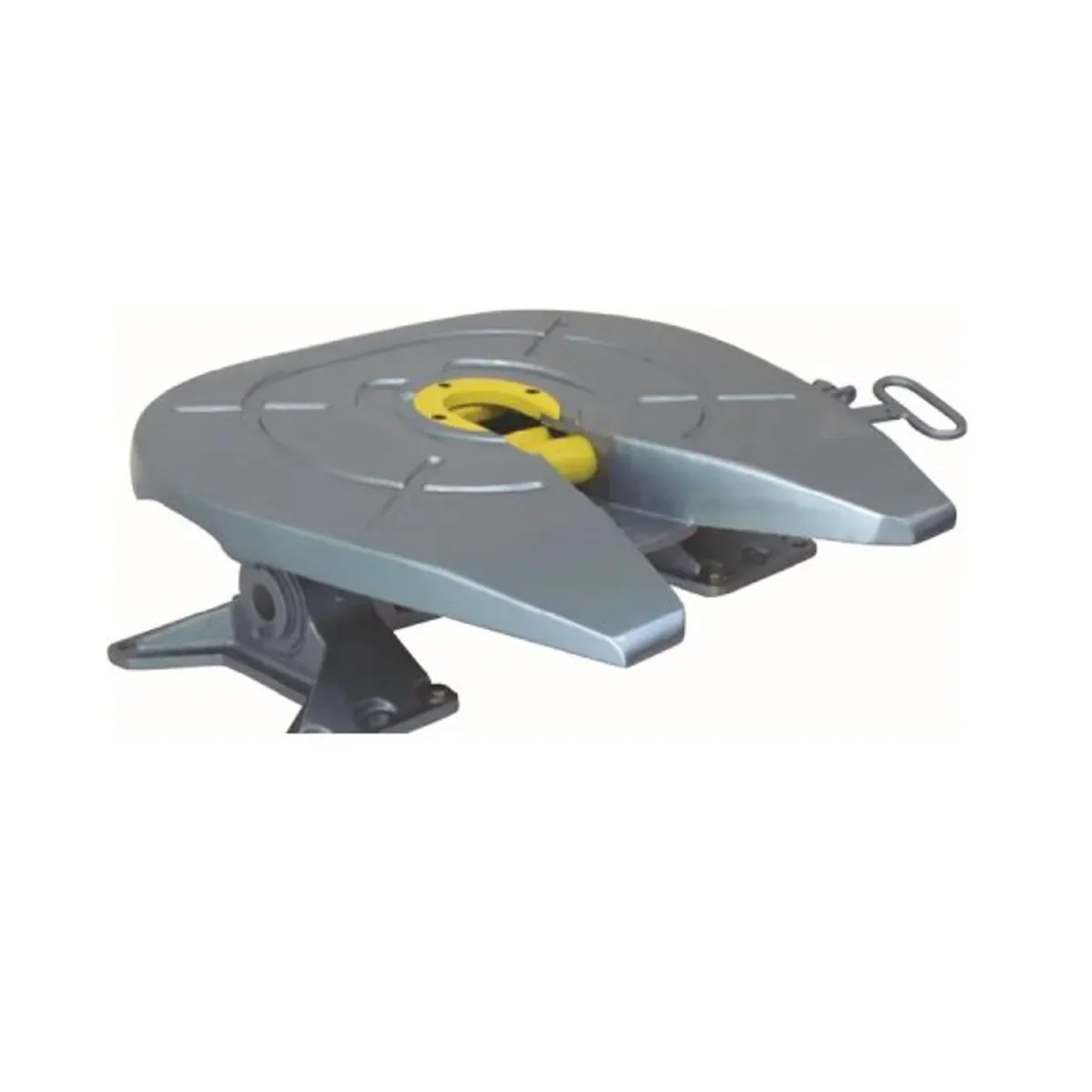
Fifth Wheel Coupling Types: Fixed, Sliding, and Compensating
Every fleet buyer eventually has to choose between the three main fifth wheel coupling types, and the decision has more to do with trailer flexibility than price. A fixed fifth wheel is bolted directly to the tractor frame at a set position. It is the simplest of the fifth wheel coupling types, the lightest, and the easiest to maintain, but it locks the tractor into one wheelbase and one weight distribution. Most day-cab tractors running dedicated lanes use a fixed fifth wheel because there is no need to shift the coupling point for different trailer lengths or axle loads.
A sliding fifth wheel rides on rails bolted to the frame, letting the driver move the entire fifth wheel plate forward or backward — typically 20 to 24 inches of travel — to redistribute weight between the tractor's drive axles and the trailer's axles. This matters most when a fleet runs mixed trailer lengths or needs to stay within axle weight limits on different loads. The tradeoff is more moving parts: slide rails, a locking pin, and an air or mechanical release that all need periodic inspection as part of fifth wheel maintenance.
A compensating fifth wheel — sometimes just called an oscillating fifth wheel — adds a pivot that lets the plate rock a few degrees side to side. This absorbs frame twist when a tractor crosses uneven ground, which is why a compensating fifth wheel is standard on off-road, logging, and heavy tank-trailer applications where the chassis flexes more than a highway tractor. Fleets running only highway lanes usually do not need this feature; fleets moving into construction or oilfield work usually do.
All three types share the same core component: the fifth wheel plate, the flat steel casting that the king pin locks into. Plate wear, not the mounting type, is usually what determines coupling replacement timing — see our fifth wheel coupling range for OEM-spec replacement plates across all three configurations.
How Fifth Wheel Works: From Approach to Lock
Understanding how fifth wheel works starts with the throat — the V-shaped opening cut into the front of the fifth wheel plate. As the tractor backs under the trailer, the king pin slides into this throat and pushes back two spring-loaded locking jaws. Once the king pin passes the jaws, they snap closed around its neck under spring tension, and a locking bar drops in behind them so they cannot open again under load. That locking bar, the jaws, and the release handle together make up the fifth wheel lock mechanism — the part that actually holds the trailer to the tractor, not the plate itself.
The driver confirms the lock two ways: a visual check of the release handle position (it should sit flush, not extended, when locked) and a tug test — pulling the tractor forward gently against the king pin to confirm the jaws hold. Skipping this step is a common cause of coupling separation incidents, and it costs nothing but thirty seconds.
Release works in reverse: the driver pulls the release handle, which retracts the locking bar and lets the jaws spring open, freeing the king pin as the tractor pulls away. On sliding fifth wheels, a separate slide-lock pin must be disengaged before the plate itself can move — a step drivers unfamiliar with a given fleet's equipment sometimes forget, leading to a jammed slide.
Wear in this mechanism shows up first as king pin play — a faint knocking felt through the cab when accelerating or braking — long before a jaw actually cracks. That play is the earliest, cheapest-to-fix warning sign in the entire fifth wheel maintenance schedule. Grease channels cut into the plate surface reduce friction as the trailer pivots during turns; a dry plate does not fail outright but it transmits far more torque into the locking jaws and accelerates their wear, which is why plate lubrication is checked at the same interval as the lock mechanism itself.
2 Inch vs 3.5 Inch King Pin: Choosing the Right Fit
North American and most export trailers use one of two king pin diameters: 2 inch (50 mm) or 3.5 inch (90 mm). The 2 inch king pin is the older, lighter-duty standard, still common on straight trucks, dolly converters, and some regional trailers. The 3.5 inch king pin is now the standard for heavy over-the-road semi-trailers because it spreads coupling load over a larger cross-section, reducing stress on both the pin and the fifth wheel plate throat at gross combination weights above roughly 36,000 kg.
The 2 inch vs 3.5 inch king pin choice is where used-trailer buyers get caught: a 3.5 inch fifth wheel will not securely lock a 2 inch king pin, and a 2 inch fifth wheel physically cannot accept a 3.5 inch king pin at all. Fleets running mixed equipment — old dollies alongside new heavy-haul trailers — sometimes standardize by swapping king pin plates rather than carrying two fifth wheel types, and that swap has to be done at the mounting bolt pattern, not just the pin itself.
Buyers importing from Russian-speaking markets should note that шкворень полуприцепа is simply the local term for the trailer king pin, and Russian spec sheets typically call it out in millimeters (50 mm or 90 mm) rather than inches — worth double-checking against the tractor's fifth wheel spec before ordering. In French-language tenders the coupling pin is called the pivot attelage, and the sizing convention is identical: 50 mm and 90 mm, no metric-only variant in between.
When in doubt, measure the existing king pin directly rather than trusting a trailer's paperwork — mismatched replacement pins from previous repairs are common enough that spec sheets cannot always be trusted. Our trailer king pins are sold in both diameters with the mounting bolt pattern matched to standard fifth wheel plates.
Fifth Wheel Height and Ride Compatibility
Fifth wheel height — measured from the ground to the top of the fifth wheel plate with the tractor unloaded — determines whether a trailer sits level, nose-up, or nose-down once coupled. Standard highway tractors run a fifth wheel height between roughly 47 and 51 inches (1,195-1,295 mm), but this shifts with tire size, suspension type, and whether the tractor is a day cab or sleeper. A trailer that sits nose-down transfers extra weight onto the tractor's drive axles and unloads the trailer's front axle group; nose-up does the opposite and can drag the landing gear or the rear of the trailer body on ramps and rail crossings.
Getting fifth wheel height right matters most when a fleet swaps tractors between trailer types — flatbeds, tankers, and reefers all have different deck heights, and a height that is correct for one combination can put another several centimeters out of level. Fleets that rotate tractors across trailer types generally standardize on a sliding fifth wheel with height-adjustable mounting brackets rather than trying to keep a single fixed height that works for every trailer in the yard.
Russian-market spec sheets refer to this figure as высота сцепки, and it is one of the first numbers a buyer should cross-check when importing a tractor unit against local trailers, since chassis height conventions differ between Chinese, European, and CIS-built tractors by several centimeters.
A rough field check: with the rig coupled and on level ground, the trailer deck should run parallel to the ground, not visibly sloped. If it is not, height adjustment at the mounting brackets — not king pin or plate replacement — is almost always the fix.
Fifth Wheel Maintenance: Lock Mechanism, Plate Wear, and Lubrication
Anyone searching for a tractor trailer fifth wheel diagram is usually trying to identify a specific part before ordering, and the layout is straightforward once labeled in words. The fifth wheel plate is the flat, roughly horseshoe-shaped steel casting bolted to the tractor frame; a V-shaped throat is cut into its front edge where the king pin enters. Two spring-loaded locking jaws sit just behind the throat, closing around the king pin's neck once it seats; a locking bar and the release handle, usually mounted on the driver's side edge of the plate, hold the jaws shut and let the driver open them from outside the cab. Grease zerk fittings are typically located at two or three points across the top surface of the plate, and on some designs a grease groove pattern is cast directly into the plate surface radiating out from the throat, so grease spreads under the trailer's own turning motion rather than needing to be worked in by hand. On a sliding fifth wheel, the mounting rails, slide-lock pin, and air or mechanical release lever sit beneath and behind the plate itself, visible from either side of the frame. Matching a physical coupling against this layout is usually enough to identify a part without needing an actual photo or diagram on hand.
A fifth wheel maintenance schedule has three checkpoints: the locking jaws and release handle, the plate surface, and the mounting bolts or slide rails — what most fleet maintenance logs simply record as 5th wheel maintenance regardless of which technical name is used. Jaws should be inspected for cracks and correct spring tension at each PM interval — a jaw that closes slowly or needs help from the driver's hand to seat is already past the point where it should have been flagged. This assembly is what Russian-speaking mechanics call the замковое устройство, the locking device, and it is the single most safety-critical part in the entire coupling.
Plate wear is measured as vertical play at the king pin bore — most manufacturers specify a maximum of around 3 mm before the plate itself needs replacing rather than just the jaws. Beyond that point, no amount of jaw adjustment restores a tight lock, because the wear has moved into the throat casting. Grease the plate surface at every service interval; a dry plate accelerates wear on both the plate and the jaws simultaneously.
Whether the search is how to grease a fifth wheel plate, how to grease 5th wheel surfaces, or simply how to grease a 5th wheel, the practice is the same: apply a liberal layer of a lithium-complex or moly-fortified chassis grease (NLGI grade 2 is standard) across the full plate surface where the trailer's underside makes contact, not just at the throat, working it into the cast grease grooves rather than leaving it in a single pile at the center. Most fleets regrease at every PM interval, or every 15,000-25,000 km, whichever comes first, and more often in wet, sandy, or winter road-salt conditions that wash grease off faster. A dry plate does not announce itself with a warning light — the signs are a grinding or chirping noise on tight turns, visible bright, worn metal on the plate surface where the trailer skid plate rides, and faster-than-expected jaw wear at the next inspection, since a dry plate transmits far more turning torque straight into the locking jaws instead of letting the trailer pivot smoothly across a greased surface.
Mounting bolts (on fixed fifth wheels) and slide rails with their locking pins (on sliding fifth wheels) should be torque-checked and visually inspected for cracked welds at the frame brackets — this is where fatigue failures actually originate, more often than in the plate itself. What Russian fleet documentation calls ремонт сцепного устройства, coupling repair, almost always starts here rather than at the jaws.
A realistic interval: full inspection every 12,000-15,000 km or at each PM service, with a driver-level lock check before every single hookup. Fleets that skip the driver-level check and rely only on scheduled PM inspections are the ones that show up in coupling-separation incident reports.
Fifth Wheel Coupling Terminology Around the World
Sigma ships fifth wheel couplings to fleets across Russian, French, Spanish, Portuguese, and Arabic-speaking markets, and the terminology varies enough to be worth listing plainly. In Russian, the assembly as a whole is the седельно-сцепное устройство (literally the saddle coupling device), sometimes shortened by drivers to седло тягача, the tractor's saddle. The trailer-side hardware is the сцепное устройство полуприцепа, and buyers researching options generally search виды сцепных устройств — coupling types — before narrowing to a specific fixed or sliding fifth wheel.
French-language markets use sellette attelage or, for the full semi-trailer coupling assembly, sellette semi remorque. The oscillating design covered above is the sellette compensée, matching the English compensating fifth wheel term for term.
In Spanish, quinta rueda is the standard term for the assembly, with quinta rueda semirremolque used when specifying the semi-trailer application specifically, and acople de quinta rueda referring to the coupling action itself. Portuguese-speaking buyers, largely in Brazil and Angola, search quinta roda, engate quinta roda (fifth wheel hitch), and prato de engate (coupling plate) — the last one mapping directly to what this guide calls the fifth wheel plate.
Arabic-language spec sheets and tenders refer to the assembly as صحن القاطرة (the tractor's plate), list أنواع صحون القاطرة when comparing coupling types, and occasionally shorten it to صحن خامس, fifth plate — the same shorthand English-speaking mechanics use.
Frequently Asked Questions
What is the difference between a fixed and sliding fifth wheel?
Can a 2 inch king pin fit a 3.5 inch fifth wheel?
How often should I inspect the fifth wheel lock mechanism?
What causes a fifth wheel plate to wear out?
Does fifth wheel height affect fuel economy or ride quality?
What is a compensating fifth wheel used for?
Is 5th wheel camper maintenance the same as heavy-truck fifth wheel coupling maintenance?
Tell us the part you need and your destination port — we'll send specs & a quote today.
Reply within 24 hours — or WhatsApp us at +86 199 5331 6215.