
Trailer Brake System Guide: How Trailer Brakes Work, Parts, and Maintenance
A trailer brake system has to work independently of the tractor, hold the trailer with no air pressure at all in an emergency, and keep working reliably across thousands of stop cycles. This guide covers how trailer brakes work, the drum brake vs disc brake trailer decision, S-cam brake components, brake chamber types, and a practical trailer brake maintenance routine.
How Trailer Brakes Work: Air Brake System Basics
A trailer brake system exists to slow and hold the trailer independently of the tractor, using compressed air rather than hydraulic fluid on every heavy-duty semi-trailer built for road use. Understanding how trailer brakes work starts with the air supply: the tractor's compressor charges two air lines running to the trailer, the service line and the emergency (or supply) line, through a set of glad hand couplings.
An air brake system trailer setup routes air first through a brake valve mounted on the trailer chassis, which controls when and how much air reaches each brake chamber, and then through a relay valve, which speeds up brake application by supplying air directly from a local reservoir rather than waiting for air to travel the full length of the trailer from the tractor. On longer trailers and multi-axle configurations, the relay valve is what keeps brake response time consistent across all axles instead of the rear axle lagging behind the front. Laid out as a semi trailer air brake system diagram, the order is: compressor, lines, glad hands, brake valve, relay valve, chamber.
If the supply line is cut, disconnected, or loses pressure, for example if the trailer separates from the tractor, the spring brakes apply automatically as a fail-safe, holding the trailer even with zero air pressure in the system. This is a deliberate safety design, not a malfunction, and it's why every trailer brake system needs a functioning parking and emergency brake valve at the front of the unit as well as the standard service brake controls.
In Russian, this entire system is referred to as тормозная система полуприцепа, and Russian-speaking fleet buyers researching the topic usually want to understand exactly this air-flow sequence, since diagnosing a slow-to-release or slow-to-apply trailer often comes down to a restricted brake valve or a failed relay valve rather than the brakes themselves. In French, the same system is called système freinage remorque; in Spanish, sistema de frenos remolque; and in Portuguese, sistema freios reboque, each covering the identical air-supply, valve, and chamber sequence described above.
Arabic-speaking fleet managers researching فرامل نصف المقطورة (trailer brake system) generally want the same fundamentals: how the service line, the emergency line, the brake valve, and the relay valve work together, since most brake complaints in the field trace back to one of these four components rather than the drum, shoe, or chamber itself. We stock the full valve and line range under trailer brake system parts.
Drum Brake vs Disc Brake Trailer Systems
The drum brake vs disc brake trailer decision comes up on nearly every new trailer spec, and in most of the world outside Western Europe, drum brakes still win on total cost of ownership even though disc brakes offer shorter stopping distances and more consistent performance in wet conditions.
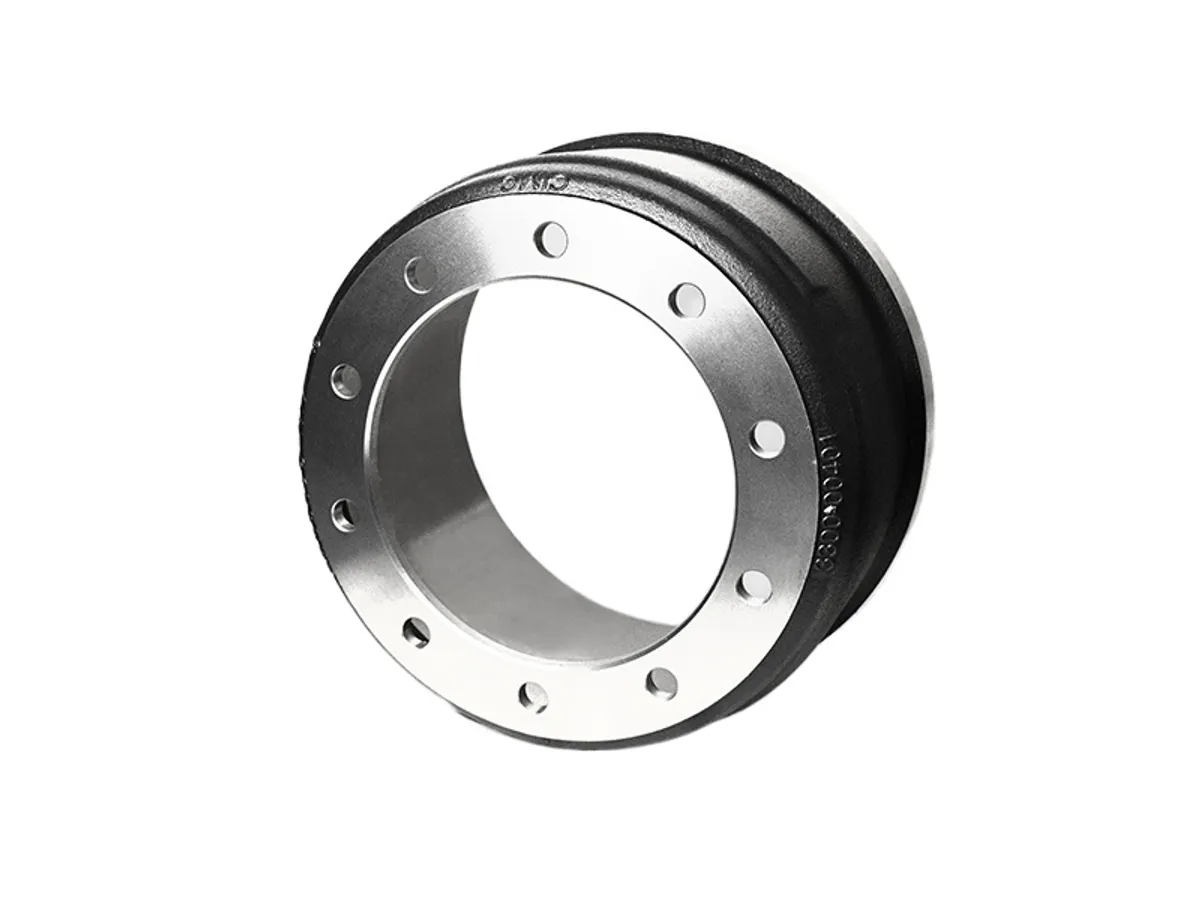
Drum brakes use a rotating drum, S-cam-actuated shoes, and a friction lining to slow the wheel, and remain the standard choice for flatbed, tipper, and general cargo trailers across Asia, Africa, the Middle East, and the Americas because they're cheaper to manufacture, simpler to service roadside, and more tolerant of dust and mud intrusion. Disc brakes, by contrast, use a caliper and rotor design closer to a passenger car, and are increasingly specified on tanker and reefer trailers in the EU where fade resistance under sustained braking, for example on mountain descents, matters more than upfront cost.
Brake drum specifications are the starting point for any drum brake order: drum diameter (commonly 410mm or 420mm on 13-ton axles), width, bolt pattern, and whether the drum is cast iron or a lighter cast-steel alloy. Getting the diameter wrong is the most common ordering mistake, since a drum that's even a few millimeters off in diameter won't seat correctly against the shoes even if the bolt pattern matches.
In Russian, the drum itself is called тормозной барабан полуприцепа, and Russian buyers typically specify diameter and bolt pattern together when requesting a quote, since suppliers in the CIS region carry both 410mm and 420mm variants for different axle brands. The French term tambour frein remorque, the Spanish tambor de freno remolque, and the Portuguese tambor de freio reboque all refer to the same component, and RFQs in all four languages should include the same diameter, width, and bolt-pattern data to avoid a mismatched delivery.
Arabic-speaking buyers researching طبل الفرامل (brake drum) for GCC and North African fleets should confirm compatibility with their existing trailer axles before ordering, since drum diameter is tied directly to axle brand and hub design, not just trailer tonnage.
S-Cam Brakes, Brake Shoes, and Lining Material
The S-cam brake is the actuation mechanism behind almost every drum brake system on a semi-trailer. When the brake chamber pushes its rod outward, it rotates a camshaft with an S-shaped profile at the brake end; as the cam rotates, it forces the two brake shoes outward against the inside of the drum. It's a simple, robust, field-serviceable design, which is a big part of why S-cam brakes remain standard worldwide despite decades of alternative designs entering the market.
Brake shoe replacement is one of the most frequent maintenance jobs on any trailer fleet, since the friction lining riveted or bonded to the shoe wears down with every stop. Brake lining material varies by duty cycle: standard organic linings suit general cargo and regional routes, while higher-temperature semi-metallic or ceramic-blend linings are worth the extra cost on tankers, mountain routes, or any fleet doing frequent hard braking, since they resist fade and glazing better under sustained heat.
In French, the shoe-and-lining assembly is generally requested as plaquette frein remorque when a fleet is ordering replacement friction components, even though the term more literally describes a brake pad; in trailer parts sourcing it's used broadly to cover both shoe linings and disc pads depending on the trailer's brake type. In Spanish, the equivalent part is zapata de freno, and in Portuguese, sapata de freio, both referring specifically to the S-cam-actuated brake shoe rather than the drum or chamber.
Arabic-speaking buyers ordering بطانة الفرامل (brake lining) should specify both the shoe part number and the lining grade, since a supplier quoting 'brake lining' alone may default to the cheapest organic compound rather than the semi-metallic grade a tanker or mountain-route fleet actually needs. As a rule, plan brake shoe replacement at the same interval as drum inspection, since a heavily worn lining accelerates drum wear on the next set of shoes if left unaddressed.
It's worth flagging that not every trailer in a mixed fleet uses this S-cam air-actuated design. Lighter drawbar trailers, converter dollies, and utility trailers sometimes run electric trailer brakes instead of air brakes, where a brake controller in the tow vehicle sends current to an electromagnet mounted on the backing plate inside each drum. When energized, the magnet is pulled against the drum's rotating armature plate, which levers the shoes outward through a separate actuating arm, a completely different actuation path from the S-cam and chamber described above. On these electric-brake trailers, the magnet itself is a wear item that eventually weakens or burns out from heat and current cycling, and a technician will need to replace the trailer brake magnet as its own job, entirely separate from replacing the friction shoes or the drum, since a fleet can have worn-out shoes riding on a perfectly good magnet, or a weak magnet still paired with fresh shoes. This is what's meant by how to adjust a brake controller, or, in trailer-specific terms, how to adjust a trailer brake controller — a separate task from how to adjust electric brakes on a trailer, which means resetting the star-wheel that sets shoe clearance.
Brake Chambers: Service, Spring, and Chamber Types
Brake chamber types split into two functional categories that are easy to confuse but serve very different purposes. A standard service chamber uses air pressure alone to push its rod out and apply the brake when the driver presses the pedal; it has no spring and releases fully once air pressure is removed.
A spring brake chamber, by contrast, combines a service section with a rear spring section holding a powerful compressed spring. Under normal driving, air pressure holds that spring compressed; if air pressure drops, whether from a supply line disconnect, a major leak, or the driver setting the parking brake, the spring extends and applies the brake mechanically, with no air pressure required. This is the parking and emergency brake function on every semi-trailer, and it's why spring brake chambers should never be manually caged (mechanically released) without following the correct procedure, since an uncontrolled release can cause serious injury.
A brake chamber size chart — sometimes labeled an air brake chamber size chart — groups chamber sizes by type number (for example, type 24, 30, or 36), which corresponds to the effective diaphragm area and therefore the force delivered at a given air pressure. Matching chamber size to axle brake torque requirements matters as much as matching the correct slack adjuster length; an undersized chamber won't develop enough force to fully apply large brake drums under load.
In French, this component is called chambre frein, and fleets typically specify both the type number and whether a spring (double) or service-only (single) chamber is needed. In Spanish, the equivalent is cámara de freno, and in Portuguese, câmara de freio; in both markets, spring chambers are the default spec on all trailer axle positions, since every trailer axle uses a spring chamber for the parking function.
Brake Adjustment and Automatic Slack Adjusters
Brake adjustment keeps the S-cam brake's stroke within spec as the lining wears; too much stroke means the brake takes longer to bite and generates more heat before full force is applied, while too little stroke can cause the brakes to drag and overheat. Automatic slack adjusters have replaced manual adjustment on the overwhelming majority of trailers built in the last two decades, since they compensate for lining wear continuously and remove one of the most commonly skipped items on a manual maintenance checklist.
Knowing how to adjust air brakes on a trailer, or, depending on how it's phrased, how to adjust brakes on a semi trailer, how to adjust drum brakes on a trailer, or how to adjust self adjusting air brakes, is still a core skill even with automatic slack adjusters fitted everywhere, since technicians need to reset stroke after a brake shoe replacement or verify that an automatic adjuster is actually holding correctly rather than freewheeling. The manual procedure: chock the wheels and release the parking brake so the shoes aren't already applied, locate the adjusting hex or square-drive bolt on the slack adjuster body, and turn it, typically clockwise to take up slack and counter-clockwise to back off, though this varies by manufacturer so check the housing markings first, in small increments while pulling the chamber pushrod by hand to gauge free travel. Stop adjusting once pushrod travel falls within the specified stroke range for that chamber size, then apply and release the brakes once and confirm the automatic mechanism re-engages on the next application, so it continues to self-adjust from the new baseline rather than sitting frozen at the manually set point.
Even with automatic adjusters installed, brake adjustment should still be checked at every service interval, since a seized or malfunctioning automatic adjuster won't self-correct and can mask a stroke problem until the brake fails to meet minimum performance during a roadside inspection.
How to adjust air brakes with automatic slack adjusters fitted, in practice, means confirming the ASA re-engages and resets after a shoe replacement or a suspected fault, not manually dialing in clearance the way a manual unit requires.
In French, the automatic slack adjuster is called a régleur automatique frein, and most European-spec trailers have required this component since automatic adjusters became mandatory on new trailers decades ago. In Spanish, the part is an ajustador de freno, and in Portuguese, an ajustador de folga, both referring to the same self-compensating mechanism mounted on the S-cam shaft. See our full slack adjusters range for both manual and automatic types.
Trailer Brake Maintenance and Sourcing Brake Parts
A basic trailer brake maintenance schedule covers four checks at every service interval: lining thickness, drum or rotor condition, chamber and valve function, and brake adjustment (stroke). Skipping any one of the four tends to shorten the life of the other three, since a worn lining accelerates drum wear, and a sticking valve keeps chambers from fully releasing, which then overheats and glazes the lining faster than normal.
Keeping a basic stock of trailer brake parts on hand, drums, shoes and lining kits, chambers, and a spare brake valve and relay valve, cuts most roadside brake failures down to an hour or two of downtime instead of a multi-day wait for parts. We supply the full range under trailer brake system, matched to both american type and german type trailer axles.
General searches for this whole product category vary by language but cover the same parts list: frein semi remorque in French, freno semirremolque in Spanish, and freio semirreboque in Portuguese all return drums, shoes, chambers, valves, and adjusters together, since fleet buyers in those markets typically order a full brake rebuild kit rather than individual components. Whatever the language, always confirm axle brand and drum diameter before ordering a rebuild kit, since a mismatched drum or chamber type is the most common cause of a returned or reworked order.
Trailer brake replacement cost varies widely by scope: a shoe-and-lining reline on a single axle position is the cheapest job in the shop, a full drum-and-shoe replacement on that same position costs several times more once the drum itself is added to the bill, and swapping chambers or valves adds further cost on top of the friction components. Fleets budgeting for a full multi-axle trailer brake replacement cost should price it per axle position first and then multiply by axle count, rather than assuming one flat trailer-wide number, since a tri-axle trailer needing a full rebuild runs roughly three times a single-axle job plus a shared valve and line inspection charge. What actually drives cost to replace trailer brakes up or down in practice is less the parts and more the labor: drum brakes require de-wheeling, pulling the drum, and resetting the adjuster on every job, so shops charge more where the work also involves diagnosing an air leak or a seized chamber rather than a straightforward reline. Trailer brake installation cost on a new build, by contrast, is typically bundled into the axle and suspension quote rather than priced as a separate line item, since drums, chambers, and valves are usually fitted as part of the axle assembly at the factory rather than retrofitted afterward.
Frequently Asked Questions
How does a trailer brake system get its air supply from the tractor?
Should I choose drum brakes or disc brakes for my trailer?
What is an S-cam brake and how does it move the brake shoes?
What brake lining material should I use for a heavy-duty trailer?
What's the difference between a service brake chamber and a spring brake chamber?
How often should brake adjustment be checked on a trailer?
What trailer brake parts should I stock for routine maintenance?
How do I adjust trailer brakes on a semi-trailer?
How much does trailer brake replacement cost?
Do trailer brakes use a magnet that needs to be replaced separately from the shoes?
Tell us the part you need and your destination port — we'll send specs & a quote today.
Reply within 24 hours — or WhatsApp us at +86 199 5331 6215.